A while back, I promoted a young woman from a rank-and-file position into one with low-to-midlevel managerial responsibilty. She now supervised three others with functions similar to her own.
I hold weekly one-on-one meetings with my direct reports, and at the most recent meeting I asked this new manager how things were going and if there were any notable problems. She signed and leaned back heavily in her chair. "Managing the processes and the work flow is a breeze," she said. "But I had no idea that managing personalities was going to be so damned hard."
Any geezer in a position of business management will smile in sympathy. This is exactly the issue in corporate management: navigating the strange and unpredictable personality conflicts and emotional baggage that otherwise competent workers bring to the workplace.
A friend of mine, an affliliate geezer, points out that as a species we have only come down out of the trees about a month ago. What he means is that we all still labor under a huge burden of fairly primitive fearful and hostile biological instincts, and that we are by no means all that civilized yet as a primate species. (If you want proof of this, just attend a professional hocky or football game, or go to a rock concert, and watch the behavior of the performers and audience very carefully.)
Nowhere is this more true than in the workplace, where apparently normal people can behave in paranoid, unconscious ways that bedevil a manager.
Here are some stereotypes that most managerial geezers will be familiar with:
• The Entitled Youngster
It's not entirely fair to say that this is a stereotype confined to young workers, though I will say you see more or it here then in other demographic groups. This is the worker who expects to succeed, or even receive praise, for almost everything he or she does. One young editor I managed, after having the same marketing piece sent back for revision several times and then finally earning praise for an adequate result, said blankly, "I had no idea it was hard to do a good job."
• The Sandbagger
This can be a worker who is otherwise smart and talented, but whom has decided to put the bulk of their effort into doing the bare minimum to get by. He will routinely arrive 30 minutes late and leave 30 minutes early, and take extra long lunches just as long as he can get away with it. If you point out to him that a particular task could have been done more completely, better, he will say: "Well, you didn't tell me exactly what you wanted." This becomes something of a mantra for this guy, as he will always say that he was lacking the full perspective on what is required—even after a decade in the job. With this guy, I give him a performance review that includes about two sentences. When he complains, I ask him to enumerate in writing all the performance standards he'd like feedback on.
• The Saboteur
This is a truly creepy character who actively seeks to undermine your company's success. It's hard to know what drives these characters, and fortunately I've known only a few over the course of 30 years. This is the one who you worry might be erasing a company file server is he's given access to it. I had an art director once who spent hours trying to get coworkers to sign a petition arguing that the color monitors being used produced harmful radiation. It was purely an effort to cause trouble. If you even suspect you've got one of these, fire them post-haste.
• The Ledbetter Paranoid
This is somebody who sees gender or age discrimination behind almost every shrub. As a manager, you very much want people who'll remind you if there are instances of unequal pay for equal work, but there are also those that see such discrimination everywhere. At one point, I used to start staff meetings with the phrase "Okay kids, let's get started." Mind you, some of these folks in attendance were even older than me. Months later, when I let an incompetent worker go, he filed a grievance arguing that my calling everybody "kids" was evidence of age discrimination on my part.
• The Procrastinator
A worker who will never, ever change. These are the folks who are just plain wired to always put things off until the last moment. There is no amount of personal coaching or career education that will create the proper habits in this guy. They never, ever, will get anything done on time. With one of these folks, I lock the door to the conference room 30 seconds after a meeting is due to start. And then yell about them missing the meeting.
• He (She) Who Is Without Sin
Occasionally you'll run into the worker who is genuinely talented at making you believe that the fault for every problem lies with someone else rather than himself. Oddly enough, this often is not a terribly conniving or deliberate act—often this fellow is really wired so as to be completely unable to recognize his own mistakes. Proper approach: continue to smilingly point out his or her mistakes, and accept no passing of the buck. Once in a great while, this type will have an epiphany and grow up.
• "Mea Culpa"
Less common, and also less problematic than "he who is without sin" is this worker, who really insists on accepting blame for almost anything. Sometimes this is simply a worker who is terribly uncomfortable "ratting out" a fellow worker who has screwed up, though occasionally you might find an example of someone who really wants scolding and discipline for some perverse reason. Usually, this is not a difficult problem to overcome, though.
• Malingerer
Very common: the guy who seems to be sick constantly. I personally don't have a problem with somebody taking a mental health day occasionally to play hooky, but there are some of these folks who treat sick leave as vacation days, and are tardy or leave early whenever they have a headache, or do all their doctor appointments on company time. Almost everybody deals with these folks, so there's no point in discussing it.
• The Control Freak
The worker who insists on having his or her hands on all reins, and who really can't trust anyone enough to delegate even the smallest detail. Seems to be more prevalent in positions of authority; in fact, you may well have been managed by this person yourself. If you manage a control freak in a mid-level position, it will take a lot of coaching to get them to loosen the reins. It can be done, though.
• Disciple of The Word
A very annoying one for me: the worker who insists that if it isn't in his job description, he can't be expected to do it. I've had some workers who really believe that before tackling anything new, they require an entirely new job description that adds a new bullet point articulating the new task. One asked me to add "sending faxes" to his job description. To which I responded "Please fax in your resignation."
• The Child of Dysfunction
Here's the worker who is quite vocal about their private misfortune, and will not only tell you about their miserable childhood or recently failed marriage, but will blame virtually every work-related problem on this fact. There's nothing wrong with having colleagues on your own level with whom you share friendly confidences on personal time, but at the point where a worker wants you to excuse their poor performance because his wife drinks too much and he never gets enough sleep, you've got a serious problem. The proper response: "Everybody has problems. Suck it up. "
—this viewpoint offered by Mercurious—
Old Geezers Out to Lunch

The Geezers Emeritus through history: The Mathematician™, Dr. Golf™, The Professor™, and Mercurious™
Friday, February 1, 2013

Wednesday, January 30, 2013
A Tale of Long Underwear
Okay, so I'll admit it. I wear long underwear sometimes. My kids would undoubtedly say something like "TMI," but there you have it.
I live in Minneapolis. It is winter-time. It is cold. I am a geezer, so my circulation is a little less robust than when I was 40. When you are facing a week with temperatures dipping to -8 to -16 degrees F. in the mornings, I'm not the only geezer commuter who will admit to wearing a layer of discreet long underwear under my business-casual attire as I brave the walk to and from the bus stops, as 20 mph winds cut like a knife.
This is a tale of long underwear.
Last week, realizing that we were in for a severe cold spell, and also realizing that my closet was under-stocked with the appropriate cold-weather under-layer, I stopped in at Target to pick up another pair or two of nice thin long-johns—the kind you can wear comfortably under clothing without feeling like an complete rube. Trust me, this can be completely acceptable attire when you live on the edge of the polar icecap—a Minnesota winter.
Some years ago, I came across a type of long-john that was very thin, not at all like the heavy, puffy white thermal underwear we geezers knew from our youths. The new version is pretty practical, and almost stylish in some ways. The fabric is a blend of something called polypropylene and other synthetics.
So I thought I was buying the same new-fangled long-underwear I'd come to appreciate as a genuine and valuable innovation. That is, until yesterday morning when the morning temp was -15 degrees and I went to get dressed in the morning.
The odd item I put on was a strangely stretchy, snug-fitting garment that required me to pull it up over my legs starting at the bottom, by sort of scrunching up the material and gradually tugging it up and up until full coverage was achieved. It was a full 60 second operation. At first I thought I must have inadvertently purchased the wrong size. But no, it was marked correctly for my current girth.
 |
| No, this not a rendition of me in my long underwear. The reality is not nearly so appealing. |
A brief bit of research tells me the following: this kind of "core" garment is designed to squeeze your legs rather fiercely, which supposedly has some merit when you exercise very harshly, in terms of keeping blood flow moving. It also supposedly lets you recover quicker from very stern athletic regimens. It is a available in both tops and bottoms, long sleeves and short, but is distinctly different the last generation polypropylene-blend underwear that I appreciated. Some NFL players wear this new stuff because they swear it causes them to ache less in the days immediately following a game.
But don't be fooled, geezers. This is really nothing more than pantyhose for men. There are no toes on these things, but putting them on certainly reminds me of the strange contortions observed when my wife puts on pantyhose. The fit must be exactly like she experiences, I imagine.
But undressing that night, I became dizzy and nearly fell over when the blood rapidly flowed back into my legs after having been forced into upward migration all day.
I may have to retire my magical underwear.
Sunday, January 27, 2013
Is Equality Really What We Want?
Last week I ran across an article in which one of the experts made the following observation: "Studies have shown that high school students with disabilities of any kind are are less likely participate in high-school sports than able-bodied students."
Well, yes. And students of middling intelligence are less likely to go on and become nuclear physicists. And boys who stutter badly are less likely to have careers as stage actors. This struck me as one of those studies that cost somebody a whole lot of money to tell us what anybody with a tiny amount of common sense already knows.
The quote came in the context of a a recent court ruling that requires schools to provide reasonable accommodations to student athletes who would like to compete but are hindered by a school's refusal to make adjustments to their special needs. So this was referring to things like a deaf track runner having a bright strobe light in addition to the starters gun to help him or her get off the blocks; or a blind wrestler having modest refereeing accommodations to allow him to compete.
I have no problem with these kinds of common sense solutions. But it did make me think a bit about some of the inadvertent problems wrought by the well-intentioned Americans with Disabilities Act and other such pieces of legislations and public policy. As I compare American approaches to these issues with European, for example, I wonder if we're doing ourselves some disservice by this far-reaching effort to level the playing field for virtually everyone.
I've been in federally funded wildnerness parks, for example, where miles upon miles of nature trails have been paved over with asphalt so as to make it possible for wheel-chair bound visitors to enjoy. That's well and good, but usually what you see on these trails are not wheelchairs, but motorized scooters piloted by people who, frankly, aren't so much disabled as just too corpulent to walk comfortably. Is it really logical to ruin the experience for the many so that the few can enjoy the experience of nature? The presence of this paving over a wilderness trail I'd once enjoyed certainly compromised the enjoyment for myself and likely for every other able-bodied hiker who appreciates natural wildness. Why are our rights less important?
In historic locations along the eastern seaboard, you seem many classic tourist sites with their architectures ruined because handicap accessible elevators or ramps have been added in accordance with laws. Is this really better than the European model, where historic sites remain historic, and disabled visitors must compromise a little on their access? But, America is the land of equality, where everyone must be the same. You can rest assured that if Mr. Everest was in the US, we'd be looking for ways to make it accessible to all.
In public schools, the policy is to mainstream students of all abilities in the same classrooms, with the result that bright, overachieving youngsters have their progress slowed down as teachers and aids accommodate behaviorally challenged or physically limited students. In the typical classroom today, a misbehaving student with emotional problems gets far more attention than the best and brightest. Is this really better than the situation back in the early days for us geezers, when schools had special education classes where kids with unusual needs were addressed by teachers who had been specially trained in meeting those needs? But, we're told, that policy makes those children feel DIFFERENT, whereas we want them to feel they are exactly the same. And we're quite willing to bring the best and the brightest down, and disable them educationally, in order to achieve this egalitarian idea.
In public transit, virtually all buses and trains are now equipped with hydraulic lifts and special seats to allow disabled people to use them. This inevitably costs lots and lots of money, reduces the space for able-bodied passengers, and of course compromises the speed of the commute for almost everyone. Is it really better to do it this way, rather than the method once used—which was to designate vehicles for the service of disabled riders; if you were wheelchair bound and needed a ride, an equipped van would come and pick you up and deliver you to your destination. I'm told that the hydraulic lifts installed on all Minneapolis public buses cos a bout $17,000 each. On a typical month of commuter riding, I might see the lift used once, and on some months not at all. That money would buy a lot of individualize shuttle rides. But the point, of course, is that in America, we believe that everybody MUST be equal, and a disabled commuter who had to take a taxi, well, he would fee DIFFERENT, and we can't have that.
I have the advantage of course, of being relatively able-bodied, and neither of my kids dealt with serious limitations of any kind while they were in school. And while I was recovering from a bad knee injury a couple of years ago, it was nice that the bus I rode could extend a metal tongue and hoist me into the bus, allowing me to bypass the steps. But think I would have been equally fine on specially designated vehicle that did the same thing and did not put the other commuters at such an inconvenience. Taking a taxi would have been fine, too, especially if the cost was subsidized for my situation.
I'm quite sure if I, or a close family member or friend, had a serious disability that I'd furiously want every and all accommodations to my situation. But at a macro level it seems to me that we've now reached a point where the needs of the very few often overrides the needs of the many. The goal of democracy is to protect the rights of the minority, I know, but I don't remember that this meant that minority rights trumped those of the majority.
An unpopular stance for a liberal geezer to take, I know. I can hear my more strident liberal friends take me to task already. And I'm certainly not arguing that simple, practical, cost effective accommodations shouldn't be made for our citizens with disabilities. When a new public building is constructed, it makes sense to put in ramps and elevators. A school district who can't arrange for a bright strobe light so that a deaf sprinter can complete should be ashamed of itself. But the practical mind says that there's a limit to what I can expect my society to do for me. I am short and would like to play basketball. Should I expect legislation mandating that the basket be set to a height of 7 ft?
I remember a short story by Kurt Vonnegut, in which the social effort to make everybody equal reached such an absurd degree that pretty people were forced to wear ugly masks in order not to make homely people feel bad about themselves; and strong, athletic people had to carry heavy lead weights so as to make them more like the physically weak. I can't help but think about this when I see a pristine wilderness trail paved over with asphalt.
—this viewpoint comes to you courtesy of Mercurious—
Well, yes. And students of middling intelligence are less likely to go on and become nuclear physicists. And boys who stutter badly are less likely to have careers as stage actors. This struck me as one of those studies that cost somebody a whole lot of money to tell us what anybody with a tiny amount of common sense already knows.
The quote came in the context of a a recent court ruling that requires schools to provide reasonable accommodations to student athletes who would like to compete but are hindered by a school's refusal to make adjustments to their special needs. So this was referring to things like a deaf track runner having a bright strobe light in addition to the starters gun to help him or her get off the blocks; or a blind wrestler having modest refereeing accommodations to allow him to compete.
I have no problem with these kinds of common sense solutions. But it did make me think a bit about some of the inadvertent problems wrought by the well-intentioned Americans with Disabilities Act and other such pieces of legislations and public policy. As I compare American approaches to these issues with European, for example, I wonder if we're doing ourselves some disservice by this far-reaching effort to level the playing field for virtually everyone.
I've been in federally funded wildnerness parks, for example, where miles upon miles of nature trails have been paved over with asphalt so as to make it possible for wheel-chair bound visitors to enjoy. That's well and good, but usually what you see on these trails are not wheelchairs, but motorized scooters piloted by people who, frankly, aren't so much disabled as just too corpulent to walk comfortably. Is it really logical to ruin the experience for the many so that the few can enjoy the experience of nature? The presence of this paving over a wilderness trail I'd once enjoyed certainly compromised the enjoyment for myself and likely for every other able-bodied hiker who appreciates natural wildness. Why are our rights less important?
In historic locations along the eastern seaboard, you seem many classic tourist sites with their architectures ruined because handicap accessible elevators or ramps have been added in accordance with laws. Is this really better than the European model, where historic sites remain historic, and disabled visitors must compromise a little on their access? But, America is the land of equality, where everyone must be the same. You can rest assured that if Mr. Everest was in the US, we'd be looking for ways to make it accessible to all.
In public schools, the policy is to mainstream students of all abilities in the same classrooms, with the result that bright, overachieving youngsters have their progress slowed down as teachers and aids accommodate behaviorally challenged or physically limited students. In the typical classroom today, a misbehaving student with emotional problems gets far more attention than the best and brightest. Is this really better than the situation back in the early days for us geezers, when schools had special education classes where kids with unusual needs were addressed by teachers who had been specially trained in meeting those needs? But, we're told, that policy makes those children feel DIFFERENT, whereas we want them to feel they are exactly the same. And we're quite willing to bring the best and the brightest down, and disable them educationally, in order to achieve this egalitarian idea.
In public transit, virtually all buses and trains are now equipped with hydraulic lifts and special seats to allow disabled people to use them. This inevitably costs lots and lots of money, reduces the space for able-bodied passengers, and of course compromises the speed of the commute for almost everyone. Is it really better to do it this way, rather than the method once used—which was to designate vehicles for the service of disabled riders; if you were wheelchair bound and needed a ride, an equipped van would come and pick you up and deliver you to your destination. I'm told that the hydraulic lifts installed on all Minneapolis public buses cos a bout $17,000 each. On a typical month of commuter riding, I might see the lift used once, and on some months not at all. That money would buy a lot of individualize shuttle rides. But the point, of course, is that in America, we believe that everybody MUST be equal, and a disabled commuter who had to take a taxi, well, he would fee DIFFERENT, and we can't have that.
I have the advantage of course, of being relatively able-bodied, and neither of my kids dealt with serious limitations of any kind while they were in school. And while I was recovering from a bad knee injury a couple of years ago, it was nice that the bus I rode could extend a metal tongue and hoist me into the bus, allowing me to bypass the steps. But think I would have been equally fine on specially designated vehicle that did the same thing and did not put the other commuters at such an inconvenience. Taking a taxi would have been fine, too, especially if the cost was subsidized for my situation.
I'm quite sure if I, or a close family member or friend, had a serious disability that I'd furiously want every and all accommodations to my situation. But at a macro level it seems to me that we've now reached a point where the needs of the very few often overrides the needs of the many. The goal of democracy is to protect the rights of the minority, I know, but I don't remember that this meant that minority rights trumped those of the majority.
An unpopular stance for a liberal geezer to take, I know. I can hear my more strident liberal friends take me to task already. And I'm certainly not arguing that simple, practical, cost effective accommodations shouldn't be made for our citizens with disabilities. When a new public building is constructed, it makes sense to put in ramps and elevators. A school district who can't arrange for a bright strobe light so that a deaf sprinter can complete should be ashamed of itself. But the practical mind says that there's a limit to what I can expect my society to do for me. I am short and would like to play basketball. Should I expect legislation mandating that the basket be set to a height of 7 ft?
I remember a short story by Kurt Vonnegut, in which the social effort to make everybody equal reached such an absurd degree that pretty people were forced to wear ugly masks in order not to make homely people feel bad about themselves; and strong, athletic people had to carry heavy lead weights so as to make them more like the physically weak. I can't help but think about this when I see a pristine wilderness trail paved over with asphalt.
—this viewpoint comes to you courtesy of Mercurious—
Wednesday, January 23, 2013
Whose Sidewalk (or Movie Theatre) Is It Anyway?

The moment seems ripe for a reawakened
ability for Americans (starting with Congress!) to work together. Whether it is politics, education or even
organizations like the Rotary Club or American Legion, things we once could
count on to bring us together seem to be under significant pressure, and the
wishes and habits of individuals and small sub-groups present themselves with
more and more strength and urgency.
Multiple meal options are expected in school lunch to accommodate
health, religious and lifestyle preferences; flexible work schedules make it
difficult indeed to attract and rehearse a community choir; community-wide
civic events and celebrations find it more and more difficult to attract
volunteers and participants. Our
president may ask us to seize our moment together, but do we have enough
practice in collective action to follow through on his urging?
Some social commentators have pointed to
what they call “affluenza” as a possible influence diminishing our ability to
engage in collective action. Briefly
described, they say that the more affluent we become as a society, the less
invested we NEED to be in fostering collective action. We become more individual in our
perspective. Instead of supporting a
local community center, we build a swimming pool in our back yard; support for
public transportation decreases as automobile ownership increases. Perspectives
understandably start to tilt away from the collective toward the individual.
What can or should be done about this? How can we strike the best possible balance between the individual and the collective, between private and public, between dependence and independence? In order to balance the needs of the individual with those of collective society, it would seem to be essential to first agree on what realms of our existence are individual/private, and which are collective/public. I would argue that among the many factors that hinder us from intelligently addressing these challenges, one is that the distinction between public and private seems increasing murky in our culture.
The irony is that just when we as a society
are arriving at a place where we should/must begin to discuss public/private
balance, we seem to be losing our ability to clearly define each. What do I
mean by this? By way of illustration, I
will cite three areas where we are profoundly mixed up about the distinctions between
public and private; between individual and group behaviours.
Is a public sidewalk (or any pedestrian egress) public or private?
This would seem to be a no-brainer. In fact when I began to type “sidewalk” into
the question above, my fingers instinctively added “public” before it—such is
the assumption society has previously made regarding this space. But look around you (if you’re a rare American
who walks anywhere!): the sidewalk is—functionally, for the majority of
users—private space. If a walker isn’t
on a cell phone, they are very likely to have their ear-buds in. Psychologically, they are in private
space—just as is the moron who loudly uses his phone call on the bus or
train. A geezer’s first impulse is to
think of most cell phone users and i-pod aficionados as rude or irritating.

Is “Business” public or private?

Is the Internet public or private?
This may emerge as one of the essential social debates of our new century. Parents are concerned about sexting; employment counsellor’s caution job seekers to carefully control what are contained on their Facebook page (to the extent they can!); arguments abound about whether a parent blogging about their child is invading the child’s privacy.
Each one is a potential minefield, and
there are explosions all over. If there
is one common thread running through many debates on Internet
culture, it is the blurring of what is private and what is public. Many
naive users open themselves to significant potential problems when they behave
like something is private when it is technologically public (or, at minimum,
easily “sharable.”)
As outrageous examples of this type of confusion are exposed, one assumes that these distinctions will become more clear. But even the proliferation of e-mail is a challenge. When asked to deal with a sensitive (private) issue through e-mail, I consider it the equivalent of a person asking to record a conversation. I admit that such a thought has more than a whiff of paranoia about it, but it’s a rare e-mail that isn’t recorded and stored. Can we consider it private? Maybe, but not with certainty.

Another major issue that the explosion of
internet culture has raised is whether “virtual” living is equivalent to
“traditional living”—whether virtual communication is equivalent to
face-to-face communication and, analogously, whether electronic “communities”
should be considered the equivalent of traditional, face-to-face communities (“regular communities” the geezer
is tempted to say.)
In his wonderful book Bowling Alone, Harvard sociologist Robert Putnam comprehensively charts the demise of many of the social structures that came to support communities through the second half of the twentieth century. He closes with a fairly desperate final chapter, in which he gallantly tries to make the case for new communities being formed through electronic means. Concern for the collective good is not diminishing, he seems to argue, it is only evolving into concern for “virtual” or electronically mediated community. Should we be concerned with such evolution? Should we value those new “civic” leaders that provide the means by which we all come “together” through electronic means in the same way we valued traditional civic contributors in the past? When one contemplates such questions, the very terms public/private or collective/individual seem ill matched or obsolete.
Is morality or honour personal or public?
Now that we’ve got warmed up on the issue, we can tackle the big one. As discussed above, with rising affluence, our culture has provided the greater and greater luxury of doing things our own way. Children having their own bedrooms are more common than ever; many of us go months—or years—without using public/shared transportation; we select our electronic entertainment when we want from among hundreds if not thousands of options. All well and good, but as our lifestyles have become increasingly individualized, so has our moral perspective. In most societies of that past, an honourable or moral person was one who subscribed to and upheld (and occasionally tried to influence or change) the collective values of their culture or subculture, be it their country, church, club neighbourhood or family. This was not just an altruistic impulse: in a more dangerous, precarious world, people’s willingness to bind themselves together and commit to a common set of behaviours could spell the difference between military defeat or victory, economic health or collapse, or making it through a long winter.
In our more individualized culture today, these existential imperatives are not as strongly present; there are fewer functional reasons to insist on individuals being consciously raised to invest in communitarian values. As a result, many—if not most—would today identify “morality” or “honour” as a thing within the personal or private realm. Who among us doesn’t believe we have a personal, informal, “code-of-honour” developed over a lifetime, upon which we rely for guidance when faced with difficult moral or ethical dilemmas? It seems sensible, doesn’t it, that personal honour is just that—a personal and individual thing.
The difficulty is that morality is most needed in public (or at least interpersonal) situations. Personal morality is fine, but when invoked, the actions one takes predicated upon that moral code almost inevitably affect (if not come into conflict with) others. As Brett in a provocative essay/blog at The Art of Manliness so convincingly argues, honour is a concept that is developed and applied between people, not within a person.
The bottom line is: America is an individualistic nation, and our independence is important to us. Living in Europe as I now do, it is striking to observe how governments and businesses impose their values and procedures upon citizens with relative ease (The “health and safety regulations that are systematically imposed by what some critics call “the nanny state” really need to be seen to be believed.) Americans tend to have a healthy scepticism toward mandated collective action. We don’t want to lose our individualism; we value our privacy. But if we lose our ability to operate politely, ethically, and morally in public, our prospects are equally grim (and much more dangerous.) What to do? It’s hard to say, but perhaps a place to start is to begin a discussion about what is private and what is public.
—This article was contributed by The Professor—
Sunday, January 20, 2013
Scene from an American Public School
Saturday saw me helping at a science competition event sponsored by the Minneapolis school system for elementary school students across the city. My wife helps coordinate these events, and I sometimes help out by running for supplies and helping with cleanup afterwards.
This particular event has teams of students build Leggo robots and then competing to complete various tasks laid down by the national event organizers. The best teams will go on to a state, then national, round of competition. It's a family affair for us; yesterday my daughter was also coaching a team from the school where she works, and my son was a zebra-striped referee helping run the actual head-to-head trials.
 As cities go, Minneapolis isn't as poverty stricken as places like the public school systems in Chicago, LA, NYC. But it still has some some neighborhood schools dominated by families on the lower end of the economic scale, others that are quite affluent, and still others where the student populations are highly mixed economically. So the school district provides bus service and boxed lunches for everybody involved in these events, as there are a goodly number who couldn't participate if they had to provide their own transportation and food. Rather than allow the richer families to transport their children to and from the events, the schools require all the team members to ride on the same bus to and from their home school to the event location. It's a good policy, I think, and one that keeps poorer students from feeling too different from their wealthier classmates.
Altogether, these are delightful events, with ingenious youngsters devising strategies to compete on an intellectual level. It has much of the cheering and celebrating you associate with sporting events, and the fact that Minneapolis sponsors this kind of academic competition is one of the things I've liked most about our public school system.
During the lunch period, I took a break in the cafeteria to watch the students and the parents who had come to support their little student science stars. We were between rounds of head-to-head competition, and a good many of the teams were taking their lunch breaks.
On one side of the cafeteria, volunteers had laid out the free box lunches for the students themselves—healthy meals consisting of a turkey and cheese sandwich, a small bag of raw carrots, an apple, a small bag of chips. A bottle of water is also provided.
But on the other side of the cafeteria we also sell concessions as a fund raiser for the program—soda pop, coffee, slices of pizza, chips—for the consumption of parents and spectators who attend. And some of the student participants who favor this kind of food and can afford it, will bypass the free boxed lunches and instead buy the pizza slices for their lunches.
At two tables near the middle of the cafeteria was a team from a school that lies on the border between relatively affluent neighborhoods and very modest ones, and as a result this school has a mixture of students. In this particular group were some little boys who were clearly from families who could afford to buy the sliced pizza and Cokes from the concession stand; their boxed lunchs sat untouched on the table as these kids devoured pizza and soda.
But two other little hispanic boys on this team, accompanied by a mother, did not immediately run for the purchased pizza line. From my seat at a nearby table, I watched them eye the pizza being devoured by their teammates and look a little sadly at their nutritious but less trendy boxed lunches, still wrapped in cellophane.
The woman with the boys—likely the mother of one of them—saw their longing, and began to dig through her bag. She eventually found $3.00 in quarters and dimes, enough so that the two little boys could also buy a slice of $1.50 pizza and feel more like other boys on the team. The little boys were thrilled, and happily ran to the pizza line and returned to join their friends.
Afterwards, the young hispanic mother waited a long time until the team members and their parents had gone back to the main gym to continue the competition. Then she helped clean up the tables, and rather than throw away the boxed lunches that hadn't been touched, she carefully packed them away in a canvas bag to bring home. She also helped clean up other adjoining tables, and when a boxed lunch had been partially eaten and she came upon untouched green apples, these too were carefully set aside to be used later.
She helped for a full hour in the cafeteria, and much later in the day I also saw her helping pack up folding chairs and tables, well after most of the parents had left. It was her way of paying for taking food that nobody else wanted.
This particular event has teams of students build Leggo robots and then competing to complete various tasks laid down by the national event organizers. The best teams will go on to a state, then national, round of competition. It's a family affair for us; yesterday my daughter was also coaching a team from the school where she works, and my son was a zebra-striped referee helping run the actual head-to-head trials.

Altogether, these are delightful events, with ingenious youngsters devising strategies to compete on an intellectual level. It has much of the cheering and celebrating you associate with sporting events, and the fact that Minneapolis sponsors this kind of academic competition is one of the things I've liked most about our public school system.
During the lunch period, I took a break in the cafeteria to watch the students and the parents who had come to support their little student science stars. We were between rounds of head-to-head competition, and a good many of the teams were taking their lunch breaks.
On one side of the cafeteria, volunteers had laid out the free box lunches for the students themselves—healthy meals consisting of a turkey and cheese sandwich, a small bag of raw carrots, an apple, a small bag of chips. A bottle of water is also provided.
But on the other side of the cafeteria we also sell concessions as a fund raiser for the program—soda pop, coffee, slices of pizza, chips—for the consumption of parents and spectators who attend. And some of the student participants who favor this kind of food and can afford it, will bypass the free boxed lunches and instead buy the pizza slices for their lunches.
At two tables near the middle of the cafeteria was a team from a school that lies on the border between relatively affluent neighborhoods and very modest ones, and as a result this school has a mixture of students. In this particular group were some little boys who were clearly from families who could afford to buy the sliced pizza and Cokes from the concession stand; their boxed lunchs sat untouched on the table as these kids devoured pizza and soda.
But two other little hispanic boys on this team, accompanied by a mother, did not immediately run for the purchased pizza line. From my seat at a nearby table, I watched them eye the pizza being devoured by their teammates and look a little sadly at their nutritious but less trendy boxed lunches, still wrapped in cellophane.
The woman with the boys—likely the mother of one of them—saw their longing, and began to dig through her bag. She eventually found $3.00 in quarters and dimes, enough so that the two little boys could also buy a slice of $1.50 pizza and feel more like other boys on the team. The little boys were thrilled, and happily ran to the pizza line and returned to join their friends.
Afterwards, the young hispanic mother waited a long time until the team members and their parents had gone back to the main gym to continue the competition. Then she helped clean up the tables, and rather than throw away the boxed lunches that hadn't been touched, she carefully packed them away in a canvas bag to bring home. She also helped clean up other adjoining tables, and when a boxed lunch had been partially eaten and she came upon untouched green apples, these too were carefully set aside to be used later.
She helped for a full hour in the cafeteria, and much later in the day I also saw her helping pack up folding chairs and tables, well after most of the parents had left. It was her way of paying for taking food that nobody else wanted.
Friday, January 18, 2013
Evolution, No Longer a "Theory"
Nothing has infuriated me more over recent years than the belief held in some quarters that "evolution" is an interesting theory, but not one that has been proven scientifically. Something called "intelligent design" is sometimes held up as an equally likely truth for how species—and specifically the human one—came to be in its present form.
In the following paragraphs, I will now demonstrate for all time that evolution is a true principle; and also that it operates both in living, reproducing organic species, and also in objects previously thought to be inanimate.
I direct you to the silverware drawer and cutlery collection in the Mercurious household.
Now, Mrs. Mercurious and I, in 33 years of marriage, have only every owned two sets of dinnerware. (Mrs. Mercurious might be embarrassed to let Geezerette friends know that we are so severely handicapped in the cutlery arena, but suck it up, I say, this is science. She would also want me to polish up the good silverware before photographing it, but here too, the speedy needs of science triumph.)
Like many families, we have one set of everyday cutlery that is used 99% of the time and which goes through the dishwasher regularly. We also have a set of "good" flatware that comes out on special occasions and gets washed by hand and carefully put away after each use.
These species of dinnerware look like this:


Mrs. Mercurious will argue that in 33 years, these assorted orphans have been abandoned by friends, neighbors and strangers who may have accidentally left behind cutlery during visits. This strikes her, I guess, as a more comfortable explanation that the genuine magic implied. But while visitors have left cell phones, liquor, gloves, scarves, etc. behind at our house, I myself rarely travel around with flatware that might be misplaced. So I find it beyond the realm of probability that random forks and spoons have slipped out of vistors' pockets or purses to gradually populate our kitchen drawer.
In the following paragraphs, I will now demonstrate for all time that evolution is a true principle; and also that it operates both in living, reproducing organic species, and also in objects previously thought to be inanimate.
I direct you to the silverware drawer and cutlery collection in the Mercurious household.
Now, Mrs. Mercurious and I, in 33 years of marriage, have only every owned two sets of dinnerware. (Mrs. Mercurious might be embarrassed to let Geezerette friends know that we are so severely handicapped in the cutlery arena, but suck it up, I say, this is science. She would also want me to polish up the good silverware before photographing it, but here too, the speedy needs of science triumph.)
Like many families, we have one set of everyday cutlery that is used 99% of the time and which goes through the dishwasher regularly. We also have a set of "good" flatware that comes out on special occasions and gets washed by hand and carefully put away after each use.
These species of dinnerware look like this:

A closeup of the genetic markers, the handle patterns, shows there are two species, and two only, present here:
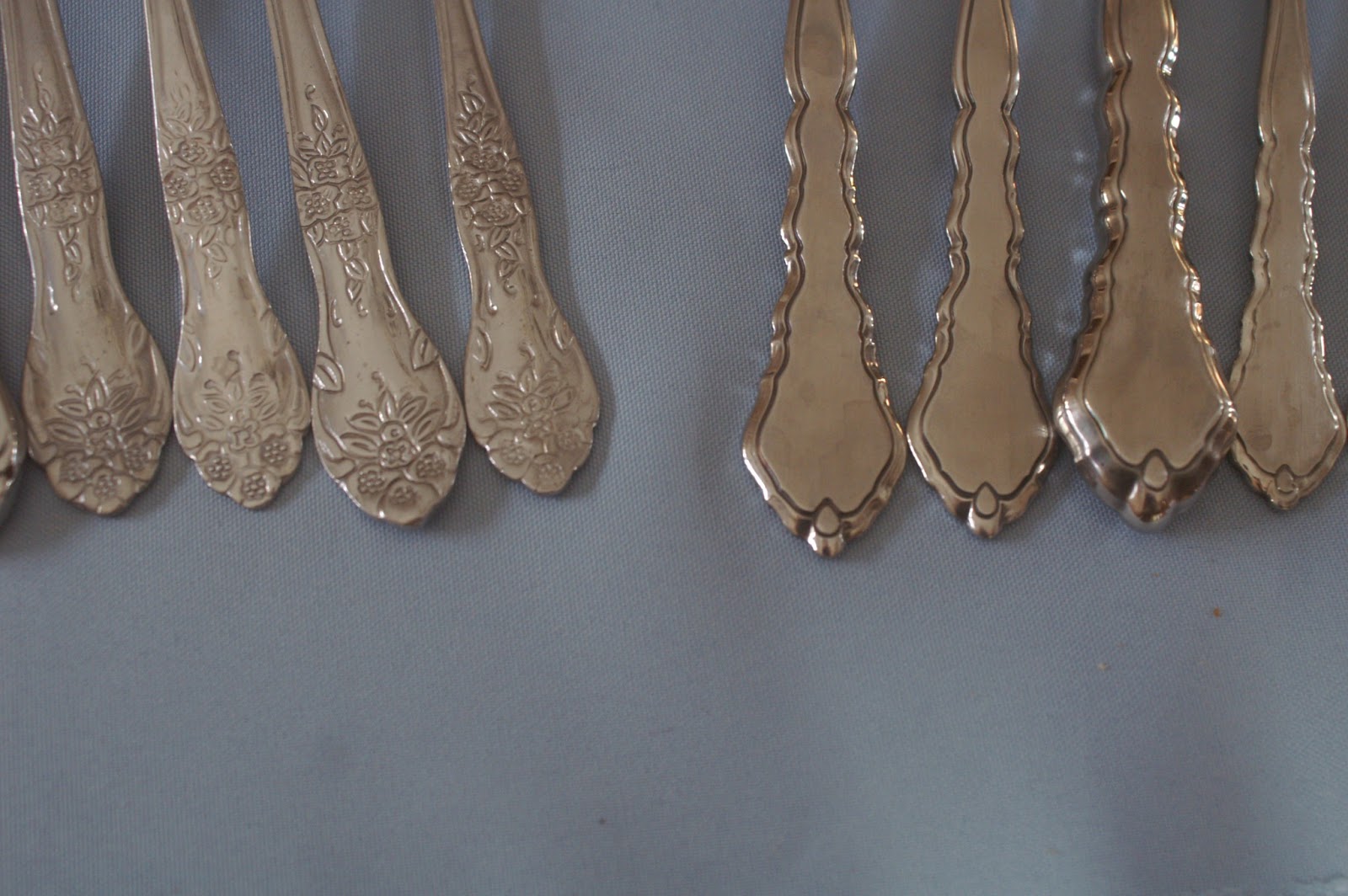
Mind you, these are the only two sets of flatware Mrs. Mercurious and I have ever owned. But within that very same silverware drawer, you can identify the following random selection of offspring, each with a distinctively different look and feel:


No, it is not migratory behavior we are witnessing; what we have in our silverware drawer in the Mercurious house is incontrovertible proof that simple parent cutlery can gradually give rise to all manner of genetically evolved offspring. I would also argue that this study may also be the definitive disproof of intelligent design as a concept: there is nothing whatsoever intelligent about this strange collection of knives, forks, and spoons.
I am now off to do an analysis of mysteriously orphaned socks abandoned over the years in our laundryroom, to see what more can be learned about this newly proven science of evolution.
Wednesday, January 16, 2013
Mercurious' 12 Favorite Movies of 2012
I've now polished off the last 2012 films on my "must see" list, and have come to my own conclusions about my favorites ones of the year. The final outliers polished off in the last week or so: Zero Dark Thirty; and The Impossible, the last knocked off on an off-evening during an out of town sales conference. (By the way, The Impossible, a film about a British family surviving the Thailand tsunami of 2004 is quite good, though not among my top dozen. Naomi Watts' performance is very good, quite worthy of her Academy Award nomination. The film might well coax tears out of hard-boiled geezers, and the tsunami effects are extremely convincing.)
No list can really pretend to be "the best." They are all only opinions of the person reviewing, after all. My own litmus test is to ask myself if the film is one I'd like to see a second time, and perhaps even a third. With that in mind, here are my choices for 2012—the movies I've either already seen twice, or will soon be adding to my collection. Some of them have now been mentioned in Golden Globes and in the Academy Award Nominations, but others might well be worth your effort to find and see.
1. Beasts of the Southern Wild. A supremely haunting mixture of social documentary, archetypal fable, and fairy tale. This is the "art film" on my list this year, which almost nobody has seen. Still, nobody had seen The Hurt Locker the year it won best picture. It's power sneaks up on you.
2. End of Watch. Unfortunately overlooked, but this cop drama is similar to Training Day, which won the best actor award for Denzel Washington. For most geezers, this will be a great surprise. A great buddy movie.
3. Lincoln. Spielberg's blockbusters can become a little tiresome—after the ridiculously maudlin War Horse, I thought he might have finally lost his touch. But here we find Spielberg back in the vicinity of Schindler's List. I would not be disappointed if Lincoln wins best picture, even though it does include the tiresome Sally Field playing herself with a slightly exaggerated accent. Tommy Lee Jones is very good. Consumate Spielberg, and perhaps his last chance at another best picture award, as he seems more prone to War Horse films these days.
4. The Hunger Games. Not on anybody's best film list, but I thought it was remarkably clever, and in fact saw it twice. Jennifer Lawrence was nominated for Silver Linings Playbook, of course, but she is similarly good here. A guilty pleasure; I'll likely take some heat from geezers for this choice. A very good soundtrack by T-bone Burnett.
5. The Queen of Versailles. Each year there is a documentary that really grabs my attention, and this is my choice this year. The film is about a wealthy couple who finds themselves hitting the skids when the real estate market plunges in the last recession. The couple would be easy to hate, but you really find yourself sensitive to their predicament. They are not bad people, just unaware of the realities of regular folks. A very good movie.
7. Django Unchained. Audacious and shocking and wonderfully interesting. Perhaps too far out there to win anything, but one I'll be adding to my Blu-ray collection, for sure. Nobody else around quite like Tarantino. Very controversial and guaranteed to elicit lots of thought and conversation.
8. Bernie. A very interesting little independent movie with Jack Black and Shirley McClain. Essentially a dramatized documentary about a strange murder case in Texas, sort of in the same vein as Kevin Spacey's movie of Midnight in the Garden of Good and Evil.
9. Seven Psychopaths. This will appeal to the same group as enjoyed Django Unchained, as it is gleefully violent, but in some ways it is even more interesting. Christopher Walken makes two films on my list this year. Hard to describe but highly recommended.
10. A Late Quartet. Christopher Walken's second movie on my list this year. Amazing tight character studies of four members of a world-class string quartet whose lives are deeply entwined. Also features Phillip Seymour Hoffman.
11. Zero Dark 30. This was ever so slightly disappointing, as it did not quite have the stunning power of Kathryne Bigelow's first big movie, The Hurt Locker, which was my #1 movie from the moment I saw it two years ago. But this one ranks right up with all the others nominated for best film this year. Bigelow is one talented film maker; you'll rarely see a movie paced or edited any better.
12. Skyfall. I liked this as well as any Bond movie, ever. And I'm quite familiar with them, as I've been working on the boxed Blu-Ray collection of the entire group. Maybe not best picture material, but a heck of a lot of fun for this geezer.
Best Picture Preferences: I would be pleased if Lincoln or Zero Dark 30 won, but will be over-the-top thrilled if Beasts of the Southern Wild walks away with the Best Picture award.
No list can really pretend to be "the best." They are all only opinions of the person reviewing, after all. My own litmus test is to ask myself if the film is one I'd like to see a second time, and perhaps even a third. With that in mind, here are my choices for 2012—the movies I've either already seen twice, or will soon be adding to my collection. Some of them have now been mentioned in Golden Globes and in the Academy Award Nominations, but others might well be worth your effort to find and see.
1. Beasts of the Southern Wild. A supremely haunting mixture of social documentary, archetypal fable, and fairy tale. This is the "art film" on my list this year, which almost nobody has seen. Still, nobody had seen The Hurt Locker the year it won best picture. It's power sneaks up on you.
2. End of Watch. Unfortunately overlooked, but this cop drama is similar to Training Day, which won the best actor award for Denzel Washington. For most geezers, this will be a great surprise. A great buddy movie.
3. Lincoln. Spielberg's blockbusters can become a little tiresome—after the ridiculously maudlin War Horse, I thought he might have finally lost his touch. But here we find Spielberg back in the vicinity of Schindler's List. I would not be disappointed if Lincoln wins best picture, even though it does include the tiresome Sally Field playing herself with a slightly exaggerated accent. Tommy Lee Jones is very good. Consumate Spielberg, and perhaps his last chance at another best picture award, as he seems more prone to War Horse films these days.
4. The Hunger Games. Not on anybody's best film list, but I thought it was remarkably clever, and in fact saw it twice. Jennifer Lawrence was nominated for Silver Linings Playbook, of course, but she is similarly good here. A guilty pleasure; I'll likely take some heat from geezers for this choice. A very good soundtrack by T-bone Burnett.
5. The Queen of Versailles. Each year there is a documentary that really grabs my attention, and this is my choice this year. The film is about a wealthy couple who finds themselves hitting the skids when the real estate market plunges in the last recession. The couple would be easy to hate, but you really find yourself sensitive to their predicament. They are not bad people, just unaware of the realities of regular folks. A very good movie.
7. Django Unchained. Audacious and shocking and wonderfully interesting. Perhaps too far out there to win anything, but one I'll be adding to my Blu-ray collection, for sure. Nobody else around quite like Tarantino. Very controversial and guaranteed to elicit lots of thought and conversation.
9. Seven Psychopaths. This will appeal to the same group as enjoyed Django Unchained, as it is gleefully violent, but in some ways it is even more interesting. Christopher Walken makes two films on my list this year. Hard to describe but highly recommended.
10. A Late Quartet. Christopher Walken's second movie on my list this year. Amazing tight character studies of four members of a world-class string quartet whose lives are deeply entwined. Also features Phillip Seymour Hoffman.
11. Zero Dark 30. This was ever so slightly disappointing, as it did not quite have the stunning power of Kathryne Bigelow's first big movie, The Hurt Locker, which was my #1 movie from the moment I saw it two years ago. But this one ranks right up with all the others nominated for best film this year. Bigelow is one talented film maker; you'll rarely see a movie paced or edited any better.
12. Skyfall. I liked this as well as any Bond movie, ever. And I'm quite familiar with them, as I've been working on the boxed Blu-Ray collection of the entire group. Maybe not best picture material, but a heck of a lot of fun for this geezer.
Best Picture Preferences: I would be pleased if Lincoln or Zero Dark 30 won, but will be over-the-top thrilled if Beasts of the Southern Wild walks away with the Best Picture award.
Subscribe to:
Posts (Atom)