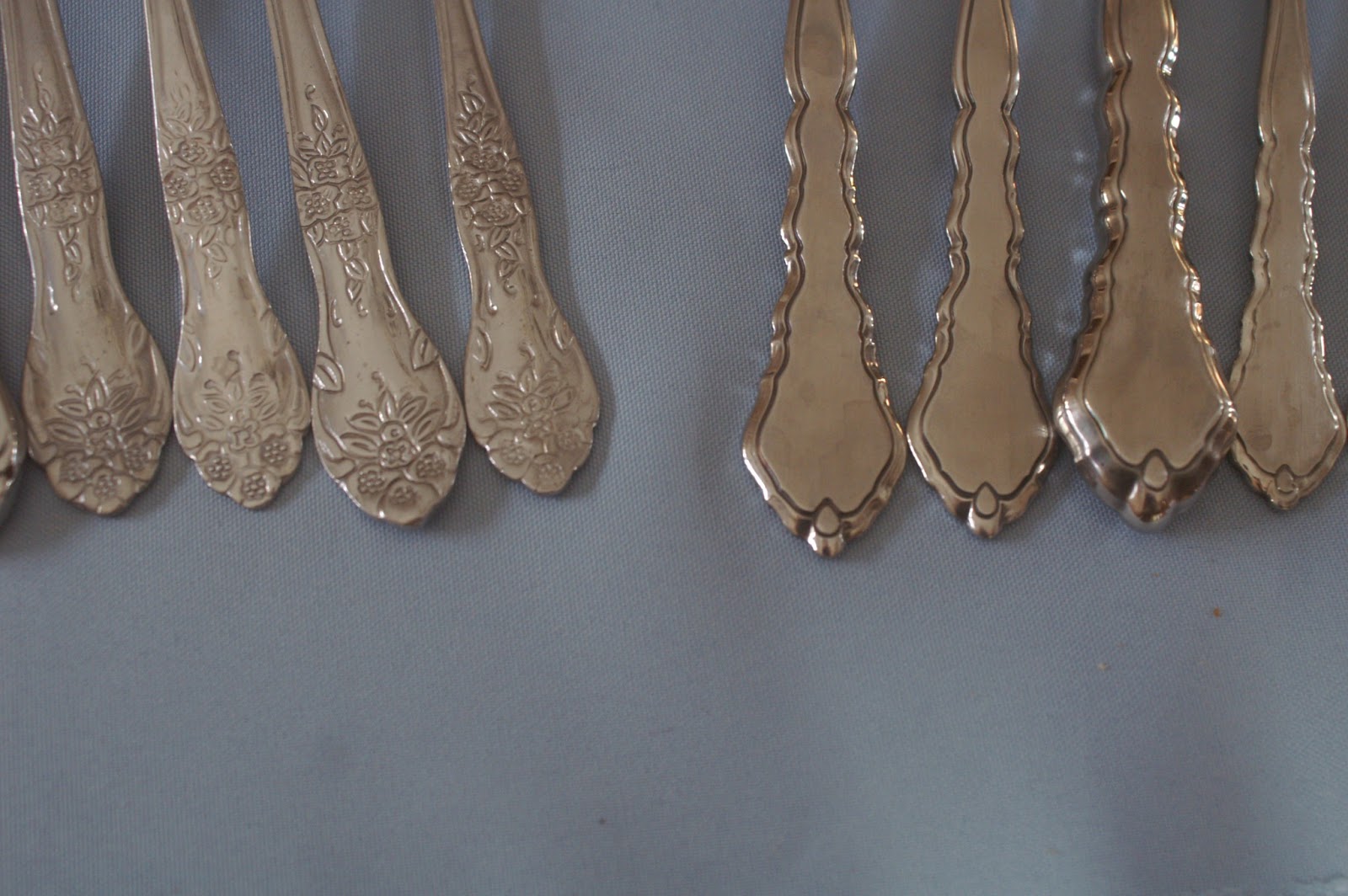
Nothing has infuriated me more over recent years than the belief held in some quarters that "evolution" is an interesting theory, but not one that has been proven scientifically. Something called "intelligent design" is sometimes held up as an equally likely truth for how species—and specifically the human one—came to be in its present form.
In the following paragraphs, I will now demonstrate for all time that evolution is a true principle; and also that it operates both in living, reproducing organic species, and also in objects previously thought to be inanimate.
I direct you to the silverware drawer and cutlery collection in the Mercurious household.
Now, Mrs. Mercurious and I, in 33 years of marriage, have only every owned two sets of dinnerware. (Mrs. Mercurious might be embarrassed to let Geezerette friends know that we are so severely handicapped in the cutlery arena, but suck it up, I say, this is science. She would also want me to polish up the good silverware before photographing it, but here too, the speedy needs of science triumph.)
Like many families, we have one set of everyday cutlery that is used 99% of the time and which goes through the dishwasher regularly. We also have a set of "good" flatware that comes out on special occasions and gets washed by hand and carefully put away after each use.
These species of dinnerware look like this:
A closeup of the genetic markers, the handle patterns, shows there are two species, and two only, present here:
Mind you, these are the only two sets of flatware Mrs. Mercurious and I have ever owned. But within that very same silverware drawer, you can identify the following random selection of offspring, each with a distinctively different look and feel:
Mrs. Mercurious will argue that in 33 years, these assorted orphans have been abandoned by friends, neighbors and strangers who may have accidentally left behind cutlery during visits. This strikes her, I guess, as a more comfortable explanation that the genuine magic implied. But while visitors have left cell phones, liquor, gloves, scarves, etc. behind at our house, I myself rarely travel around with flatware that might be misplaced. So I find it beyond the realm of probability that random forks and spoons have slipped out of vistors' pockets or purses to gradually populate our kitchen drawer.
No, it is not migratory behavior we are witnessing; what we have in our silverware drawer in the Mercurious house is incontrovertible proof that simple parent cutlery can gradually give rise to all manner of genetically evolved offspring. I would also argue that this study may also be the definitive disproof of intelligent design as a concept: there is nothing whatsoever intelligent about this strange collection of knives, forks, and spoons.
I am now off to do an analysis of mysteriously orphaned socks abandoned over the years in our laundryroom, to see what more can be learned about this newly proven science of evolution.
I've now polished off the last 2012 films on my "must see" list, and have come to my own conclusions about my favorites ones of the year. The final outliers polished off in the last week or so: Zero Dark Thirty; and The Impossible, the last knocked off on an off-evening during an out of town sales conference. (By the way, The Impossible, a film about a British family surviving the Thailand tsunami of 2004 is quite good, though not among my top dozen. Naomi Watts' performance is very good, quite worthy of her Academy Award nomination. The film might well coax tears out of hard-boiled geezers, and the tsunami effects are extremely convincing.)
No list can really pretend to be "the best." They are all only opinions of the person reviewing, after all. My own litmus test is to ask myself if the film is one I'd like to see a second time, and perhaps even a third. With that in mind, here are my choices for 2012—the movies I've either already seen twice, or will soon be adding to my collection. Some of them have now been mentioned in Golden Globes and in the Academy Award Nominations, but others might well be worth your effort to find and see.
1. Beasts of the Southern Wild. A supremely haunting mixture of social documentary, archetypal fable, and fairy tale. This is the "art film" on my list this year, which almost nobody has seen. Still, nobody had seen The Hurt Locker the year it won best picture. It's power sneaks up on you.
2. End of Watch. Unfortunately overlooked, but this cop drama is similar to Training Day, which won the best actor award for Denzel Washington. For most geezers, this will be a great surprise. A great buddy movie.
3. Lincoln. Spielberg's blockbusters can become a little tiresome—after the ridiculously maudlin War Horse, I thought he might have finally lost his touch. But here we find Spielberg back in the vicinity of Schindler's List. I would not be disappointed if Lincoln wins best picture, even though it does include the tiresome Sally Field playing herself with a slightly exaggerated accent. Tommy Lee Jones is very good. Consumate Spielberg, and perhaps his last chance at another best picture award, as he seems more prone to War Horse films these days.
4. The Hunger Games. Not on anybody's best film list, but I thought it was remarkably clever, and in fact saw it twice. Jennifer Lawrence was nominated for Silver Linings Playbook, of course, but she is similarly good here. A guilty pleasure; I'll likely take some heat from geezers for this choice. A very good soundtrack by T-bone Burnett.
5. The Queen of Versailles. Each year there is a documentary that really grabs my attention, and this is my choice this year. The film is about a wealthy couple who finds themselves hitting the skids when the real estate market plunges in the last recession. The couple would be easy to hate, but you really find yourself sensitive to their predicament. They are not bad people, just unaware of the realities of regular folks. A very good movie.
7. Django Unchained. Audacious and shocking and wonderfully interesting. Perhaps too far out there to win anything, but one I'll be adding to my Blu-ray collection, for sure. Nobody else around quite like Tarantino. Very controversial and guaranteed to elicit lots of thought and conversation.
8. Bernie. A very interesting little independent movie with Jack Black and Shirley McClain. Essentially a dramatized documentary about a strange murder case in Texas, sort of in the same vein as Kevin Spacey's movie of Midnight in the Garden of Good and Evil.
9. Seven Psychopaths. This will appeal to the same group as enjoyed Django Unchained, as it is gleefully violent, but in some ways it is even more interesting. Christopher Walken makes two films on my list this year. Hard to describe but highly recommended.
10. A Late Quartet. Christopher Walken's second movie on my list this year. Amazing tight character studies of four members of a world-class string quartet whose lives are deeply entwined. Also features Phillip Seymour Hoffman.
11. Zero Dark 30. This was ever so slightly disappointing, as it did not quite have the stunning power of Kathryne Bigelow's first big movie, The Hurt Locker, which was my #1 movie from the moment I saw it two years ago. But this one ranks right up with all the others nominated for best film this year. Bigelow is one talented film maker; you'll rarely see a movie paced or edited any better.
12. Skyfall. I liked this as well as any Bond movie, ever. And I'm quite familiar with them, as I've been working on the boxed Blu-Ray collection of the entire group. Maybe not best picture material, but a heck of a lot of fun for this geezer.
Best Picture Preferences: I would be pleased if Lincoln or Zero Dark 30 won, but will be over-the-top thrilled if Beasts of the Southern Wild walks away with the Best Picture award.
While my Buddhist leanings aren't fundamental enough to make automatically subscribe to full-blown belief in karma, it's not too hard to observe that all actions lead to consequences. In other words, while I have some trouble really believing that we reincarnate in subsequent lives on this earth, I fully believe that what we do here and now causes a reincarnation of sorts in later days. What goes around, comes around. Leading a decent, good life may not cause you to come back in better circumstances in another life after you die, but it can be transformative in this life, right here and now. Similarly, if you behave in mean, selfish ways, there will be some kind of payback in terms of quality of life and fortunes.
Michele Bachmann is Minnesota's own embarrassing representative of tea-party ignorance and bigotry. This is the woman who has argued that because the last swine flu epidemic came under Jimmy Carter, there was a causal relationship between disease and democrats; who believes that there are "hundreds and hundreds of scientists, including many nobel prize winners," who subscribe to intelligent design; whose family business is aimed at "curing" gay people of their transgressions against God; who believes that it is unconstitutional for the government to conduct a census.
There is no more paranoid, parochial person in politics—so much so that even writing a blog entry about her will put you on the Bachman organization's radar. Bachman comes from the Richard Nixon camp of political paranoia, clearly. My own brother, after writing a critical letter about Michele Bachmann's stance on gun control, was investigated in person by authorities at the request of the Bachmann organization.
A recent news story, though, suggests that the "what goes around comes around" adage is now starting in motion. Bachmann is now being investigated for certain legal violations that involved stealing a list of home-school families in Iowa in order to campaign direct to them before the primary last year. Now, in terms of political corruption, this is very small potatoes, indeed. Our own beloved Hubert Humphrey routinely did far more outrageous things in terms of campaign strategy. In and of itself, this is no story at all.
But now the campaign organization is holding back salary payment from staffers until they sign confidentiality agreements to prevent them from leaking details of campaign strategies and illegalities. Such is the paranoia of the organization that they fear the secretaries who are owed $900 or $1000 will sabotage Michele's fortunes by leaking details to the press.
Now, this may be wishful thinking on the part of this liberal, but I'm predicting that we are now seeing the start of a gradual fall from national prominence to widespread ridicule and disgrace for the Teabagger Queen. The district Michele represents is one of the most conservative in all Minnesota, but even they are not ignorant enough to look away when it comes to financial extortion. The only thing worse than taking away a teabagger's handgun is taking away his money.
You heard it here first: Michele Bachmann will not win another election. The karma of paranoia is beginning to ripen.
Over at The Art of Manliness, Brett has been writing a fascinating series of articles on the subject of manly honor. You can read it here.
It's striking to recognize the degree to which the Geezers of these pages practice a life of manly honor (here at Old Geezers Out to Lunch, we are nothing if not confidently aware of our virtue) , but there is still much in Brett's articles for men of all ages and predispositions to reflect on.
So here are some open-ended question for the Geezers Emeritus, as well as anyone on our mailing list and everyone who stumbles into Old Geezers Out to Lunch. Please do add your responses and observations in the comment feature at the bottom of the page. This post will stay active so long as the conversation chain evolves.
In this time and this place, what does it mean to live with honor? If you are a geezer, how do you define it for yourself? If you know a geezer, how do you observe honor manifesting? Does honor mean the same today as it did 'back in the day'? Or is is it less relevant in today's world? Is there anything unique about the oft-discussed "male honor"?
Once men make peace with being middle aged, there comes a point when they begin to suspect the onset of approaching Geezerhood. To the truly conscious, it is quite evident when that occurs, but alas, few of us are really that self-awere. Never fear: Assembled by the Council of Geezers (a newly recognized organization), here are 12 signs that Geezerhood is upon you. Recognizing yourself in any one of these allows you to apply for membership in the club.
Keep going...lower....lower....
1. When an on-line account asks you to define your birth year during registration, you now need to scroll nearly to the bottom of the drop-down list to find it. Startled, you realize you were born barely 10 years after World War 2.
2. You prefer your E-book reader not because it's cool technology, but because you can set the print large enough to read without glasses. 3. Your wife rubs her palm in the center of your back in the middle of the night not because she's feeling frisky, but because you're not snoring and she's checking to make sure you're still breathing.
4. You check your 401k account balances weekly, and you genuinely understand the concept of "equity." You actually fret over the question "Bonds or stocks?"
Robert Plant: Lead singer of Led Zeppelin,
and Geezer extraordinaire
5. The Kennedy Center Honors programs has become much hipper in recent years, obviously. Once mired in the likes of Martha Graham, Helen Hayes, and Jimmy Cagney, the program now has the great good sense to honor Springsteen, Dylan, David Letterman, and Led Zeppelin.
6. Your kids no longer treat you like stern gods, and you have also passed through the period where you're a moron; they now interact with you like regular people. Enjoy it: the tolerant pity phase is just down the road.
7. On cable television, the History Channel, Discovery, and the Weather Channel are far more interesting than HBO or Showtime. You'd rather watch "Hoarders" and "Pawn Stars" than "Breaking Bad" and "Mad Men." Everglades pythons exploding after they swallow alligators is more intriguing than bare boobies on "Boardwalk Empire."
8. "Spam" for you will always be a suspicious canned meat from the Hormel meat company. You've given up trying to understand the other kind of spam, or why we should be scared of it.
9. Having sex on the floor no longer has any appeal whatsoever. And man-on-bottom is preferred for a single reason: it's easy on the back.
10. When you exercise or work hard, the sweat soaking through your sweatshirt radiates out from your navel area, not your pectoral muscles. And you've now forgotten just when it was that your waist measurement began to exceed your inseam. You now understand those poor guys who cinch their trouser belts up at a point just below the armpits.
"Hey, buddy, wanna score
some primo Kava? Cocktailhour
without the hangover."
11. Rather than knowing all the different types of marijuana currently in circulation, you are now knowledgeable about the natural herbal cures for prostate trouble, high cholesterol, jet lag. You get your stash at Whole Foods, not at the northwest corner of Franklin St. & Chicago Avenue on Saturday night.
"Wasn't me. Was it you?"
12. When standing at a urinal in a public restroom, you no longer have the muscle control necessary to hold back flatulence while peeing: it's all or nothing. And you're not really very embarrassed about it.
This film will be highly polarizing: you will either have your socks blown off by it, or you'll be utterly disgusted. A few people may have both responses (this was true for a geezer friend of mine, who was stunned in a way that nearly caused him to walk out).
Quentin Tarantino tends to elicit this kind extreme reaction in audiences, and Django Unchained is no exception. My own view is that it's an exceptionally fine movie, but lord almighty is it shocking and brutal. I found myself averting my eyes a dozen times, even while I winced and laughed at the over-the-top humor of the thing.
It's rather hard to discuss the movie without giving a whole lot a way and spoiling it for potential viewers, so instead I'll give some diagnostic questions to help you decide if this movie is appropriate for you:
• You are able to watch movie violence and over-ride your suspension of disbelief in a way that lets you enjoy the pure demonstration of special effects.
• You can see potential for finding humor in a raid by a KKK lynch mob.
• You enjoyed movies like Pulp Fiction, Fight Club, Seven Psychopaths.
If you can answer yes to at least two of these, you can probably safely see Django Unchained.
Tarantino is so invested in shocking normal attitudes that I'm not sure he'll ever get nominated at the Golden Globe or Academy level; but if he does, this might be the movie that does it. Mrs. Mercurious, bless her soul, is great at appreciating the same kind of movies as me, and she liked this one much better than Pulp Fiction—which she loved. A word of warning, though: it's likely a rare member of the feminine geezer club who can get ride this vehicle—it has the potential for badly sickening the faint of heart. It might be a move best enjoyed "with the boys." Not exactly a date movie.
Django Unchained is blessed with some exceptionally fine supporting roles, so much so that it would be difficult to pick who might get supporting actor nods. Christopher Waltz is, if anything, even better than he was as the Nazi you loved to hate in Inglorious Basterds. Samuel L. Jackson (of Pulp Fiction fame) is also astounding. The biggest treat, though, might be Leonardo DeCaprio, who makes a villainous turn here that is exceptionally fine. There comes a moment where DeCaprio shifts from amiable evil to truly disturbing perversity in a way that will make you rethink Leo's abilities as an actor. Any one of the three is quite worthy of best supporting actor.
I cannot think of a movie that has stuck in my head quite the way this one has. If you are really willing to challenge your soul, you might do a long double-feature matinee, seeing Spielberg's Lincoln in the early showing, then taking the electroshock treatment of Django late in the day. The close juxtaposition of the two movies will mess you up for weeks.
These may well be the two best movies of the year, and they ostensibly deal with the same subject matter (slavery) in an historical time period only 10 years or so apart.
And you will never see two movies that are so good, and yet so unlike one another.
The IT guy at work told me the other day that, as part of the new security measures, I would need to change my log-on password to the corporate file server each and every month. And I could not reuse any previous password.
"No." I said flatly. "That's the last straw. I can't do this any longer. Either I keep the same password, or I'll find ways to make your life a living hell." In reality, I can't really do much to this IT guy, other than occasionally temporarily withhold a signature he needs to buy new hardware or software. Though he doesn't know it, his power over me is far greater than mine over him. Perception is it's own reality, though, and he believes that my senior status makes me someone to be heeded.
I had just had enough. Ten years ago, or even five years, computer passwords were a breeze. I think I perhaps had one email password, and another for the corporate file server. Not all that long ago, two passwords were plenty.
Gradually, thing proliferated, and eventually got to the point where the number of required passwords is in the dozens. I now have to keep them written down in a little cheat sheet notebook. Mind you, I don't password-protect my home personal computer or cell phone, or anything else where you have an option not to. It's really only the essential accounts, or those where it is mandatory, where I use passwords.
Even with this minimalist approach, I counted the other day and came up with 39 various on-line accounts or memberships that require passwords for me to remember. Given that I have trouble remembering whether my most recent birthday was the 57th or 58th , you can see the dilemma that I'm in.
A quick survey: 4 on-line banking accounts (one personal, three business accounts; 3 airline frequent flier accounts; 4 credit card accounts (three personal, one business); 3 health care accounts (one for my GP doctor, one for a specialist, and one for my flex-spending health account); 6 professional groups (mostly relating to the publishing industry); 2 investment/retirement accounts; 3 social media accounts (two personal, one professional); 5 home entertainment accounts (things like I-Tunes, Netflix, Amazon, Comcast), 3 website/blogging accounts; and a number of single accounts for things like various on-line merchants that the family uses routinely.
For awhile, it was easy, because I just used the same password over and over. But then out of spite or sadism, the accounts began to insist on diabolical variations: your password had to be at least 14 characters (or nine, or 17) in length, and it had to include an uppercase letter, and 3 numbers, and a symbol—and it couldn't use any portion of your own name. And now it was not only a password, but you had to create a user name, as well, which had its own set of arcane requirements.
I really do imagine that there are some twisted young adults who dream this stuff up, because just when you got this part down, they started adding "security questions" to the mix. At first it was easy enough: your mother's maiden name; name of your first school. But pretty soon it wasn't a single security question, but two or three. Recently, I was faced with an account that required you to pick five different questions among a possible ten. And only two of them were slam dunks. Among the others, I had to pick from "best childhood friend," "favorite author," "job you wanted when you were growing up," and "street where you grew up."
Now, my answers to these are variable, or impossible. I had a bunch of good friends growing up, and which was the favorite varied from moment to moment: are we talking kindergarten or seventh grade? My favorite author will depend on my mood: there are at least five that are favorites at different times. Growing up, there were times I wanted to be an author, times when I wanted to be a geologist, times when I wanted to be a doctor, not to mention the time I was set on becoming a photographer for Playboy. I didn't grow up on a street at all, but on a country road with no name at all. So I had to pick random questions and random answers, then note them dutifully in my cheat-sheet notebook so I could retrieve them in the future.
And the coup de grace: now you are forced to interpret a couple of fuzzy photos of jumbled letters and type these in, as well, before you can pass through the gauntlet and get access to a paypal account containing $17.29, which you've been too lazy to close out. This interpretation of two fuzzy words or numbers is supposed to prevent automated computer "spammers" from sending you lots of junk mail, but the real effect is to prevent ME from getting into my own accounts.
It's all quite an indignity for a geezer. If I ever appear to vanish suddenly from the world of blogging and cyber reality, it's possible that something unfortunate has happened to me. But it's more likely I've hidden my cheat sheet containing my passwords and have forgotten where I put it.
But the IT guy did manage to make an exception for me—I'll not have to change my password monthly, or ever. The tradeoff is that he assigned me the permanent password rather than letting me choose it myself.