I'm trying to stay detached while watching the political drama between House republicans and Senate democrats, though I'll forewarn you that my innate liberal bent often makes this difficult. But having spent my life in the media business, the PR drama is something to which I can bring a little more objectivity, I think. Among my observations:
• Initially, I thought it was quite brilliant of the right wing, a couple years ago, to label The Affordable Care Act "Obamacare." It is much easier for the public to oppose a social program with a alien-sounding name than it is the feel-good phrase "affordable care." When I researched this, I found that the term was cropping up in editorials way back in 2007, during the presidential election race. In any case, these journalists deserve a medal from the tea party group, since the phrase has made it much easier to galvanize opposition today.
However, this could come to haunt republicans, too, because recently even democrats have been using the phrase, and I now have the sense that if the program shows any early success at all, "Obamacare" could become similar to "Social Security" in the hearts and minds of citizens. 20 years from now, the phrase could offer echos of "New Deal" and be part of a fond legacy for Obama.... or could taint him like "teapot dome scandal" did for Warren Harding. Just too early to tell.
• It was, I thought, similarly shrewd of republicans over the last few days to repeat in speeches "if Obama can negotiate with Iran and Syria, why can't he negotiate with us?" Leaving aside for a moment the fact that what's proposed is really NOT a true negotiation, it was a shrewd PR move to enlist everyone who is conservative regarding foreign policy onto the anti-obamacare team.
If I were the democrat, though, I'd seize the opportunity and coin this phrase: "American doesn't negotiate with terrorists, not even ones in Congress."
• In the media, I think the tide is moving in the direction of the democrats. This morning as the government shutdown dawned, I could find few newspaper editorials that didn't chastise the republicans in some way. USA Today (granted, not the newspaper of the highly educated, but normally maddeningly unwilling to take a strong stand) found in their survey that 69% of readers strongly blamed the republican house for the current mess. Other notably liberal newspapers predictably blamed republicans, but not even the Wall Street Journal could must muster much fierce anti-Obama sentiment on this one, publishing only a Peggy Noonan editorial that said it would be in Obama's interest to negotiate.
....some observations on how the health care exchanges looks to me.
Minnesota has been on the forefront of establishing a state-based health insurance exchange, and when I logged onto their web site this morning, the first day of enrollment, I found it far more developed than I had been led to believe—easy to navigate and quite easy to understand and use. Using my current work-sponsored health insurance program as a standard, I found that if I were to buy insurance on the exchange for myself, my wife, and daughter (age 24), the annual costs would be around $7,000 to 8,000 a year. (Plus, in likelihood, possibly another $2,000 or so in out of pocket). That's for "platinum" coverage, a fairly comprehensive coverage similar to what I enjoy at work. Considering that I have friends of a similar age who privately insure for costs up to $20,000 per year (premiums plus out-of-pocket max), from a purely selfish point of view, the new exchange program doesn't look too bad.
It doesn't even look bad compared to our work-sponsored insurance, since my own contribution to this (one-third of total) is about $5,000 per year.
The health insurance exchange, then, wouldn't make any sense for me in a situation where my employer pays two-thirds of my current cost. But considering that I might be able to buy pretty decent annual insurance coverage for less than $10,000 per year, it does mean that retiring at 60 or 62 is a distinct possibility, rather than slaving away until 65, as I might have to do without the program. And this seems to me to be in the country's best interests: getting older workers out of the workforce to clear the way for employing youngsters.
Now, I'm not naive enough to not understand that there might be plenty of hidden costs here, not the least of which is the real concern that the program could add to the national debt, unless carefully managed and controlled. That's the argument made by intelligent conservatives, and they can make it fairly persuasively, whenever they are not drowned out by tea party shrillness.
But on a basic PR level, my suspicion is that as many ordinary people see that the current program seems to offer more affordable health insurance, they'll seize upon the selfish benefit and not worry too much about the broader implications. How many consumers, for example, worry about larger ethical issues when buying cheap clothing at Walmart manufactured by slave children in Bangladesh? We're a culture of "what's good for me," and gradually, I think, Obamacare will leave that impression for many people.
I'm not equating Obamacare with Walmart manufacturing ethics, by any means. There's just not enough evidence to know what the final outcome will be. But for once, anyway, I'm actually firmly behind the editorial I read this morning, which said "Fix Obamacare, don't eliminate it."
That's a debate we can and should be having. Not the silliness currently underway.
Old Geezers Out to Lunch

The Geezers Emeritus through history: The Mathematician™, Dr. Golf™, The Professor™, and Mercurious™
Tuesday, October 1, 2013

Monday, September 23, 2013
Grumpy Geezer Monday: Sept. 23, 2013
Grumpy Geezer Monday is an ongoing feature dedicated to the acknowledgment that, no matter how serene our hopes and aspirations, occasional surlines is a part of life that better faced head-on rather than ignored....
On this Monday, I (Mercurious) finds myself grumpy about....
Grumpiness itself. It takes me the better part of a weekend to decompress from work and fully relax, and the ramp up to the workweek which begins about 9:00 Sunday night reaches a peak on Monday morning, when all manner of innocent things have the power to irritate me. To wit:
 • The Minnesota Vikings. With a good draft and last year's late season success to build on, the hometown team has opened the season 0-3, and lost yesterday to a team roundly believed to be a preseason favorite to finish dead last in their division. Patience is a virtue, I know....but not for an NFL coach facing a team completely lacking in passion and fire and leadership. No wonder I'm grumpy.
• Al Shabaab terrorist in Nairobi, Kenya, who have killed up to 70 people in a shopping mall. Kenya in recent years is something of a success story among African nations, having been relatively peaceful and prosperous since 2002 or so. But the nation's support of anti-terrorist forces in Somalia apparently puts them in the crosshairs of Al Shabaab, whose response is to attack a western-style shopping mall in the capital. Religious fanaticism of all stripes makes me profoundly grumpy on this Monday.
• The 22-year old girl driving a red Audi S8 with vanity plates, weaving in an out of traffic on
 Lyndale Avenue like a banshee. Here's a car that costs more than the first homes that most of us owned, driven by somebody who must have borrowed it from daddy (or sugar daddy), who has done nothing whatsoever to deserve this level of wealth, and worst of all appears not to appreciate the driving experience, judging from the audible grinding of gears I hear. (Alright, so maybe this is partially just simple jealously. I asked to test-drive one of these once at an Audi dealer, and was told that I could drive anything else on the lot, including the TT, but not the single S8 they had on the lot.)
• The self-centered candidate for my open Creative Director position, who, after wasting my time in early interviews, announces that he is unwilling, after all, to relocate to take the job. Dammit fellow, you couldn't have told me this three weeks ago so I could focus on a legitimate candidate?
Thank you for listening. Having vented this bile, perhaps I'll now be able to appreciate a fine sunny autumn day on a lunchtime walk along St. Anthony falls in downtown Minneapolis. Life is good, after all. Just not always on Monday morning.
On this Monday, I (Mercurious) finds myself grumpy about....
Grumpiness itself. It takes me the better part of a weekend to decompress from work and fully relax, and the ramp up to the workweek which begins about 9:00 Sunday night reaches a peak on Monday morning, when all manner of innocent things have the power to irritate me. To wit:

• The 22-year old girl driving a red Audi S8 with vanity plates, weaving in an out of traffic on

• The self-centered candidate for my open Creative Director position, who, after wasting my time in early interviews, announces that he is unwilling, after all, to relocate to take the job. Dammit fellow, you couldn't have told me this three weeks ago so I could focus on a legitimate candidate?
Thank you for listening. Having vented this bile, perhaps I'll now be able to appreciate a fine sunny autumn day on a lunchtime walk along St. Anthony falls in downtown Minneapolis. Life is good, after all. Just not always on Monday morning.
Friday, September 20, 2013
Citizens of 4F, Sept. 19, 2013
Frank is a common though infrequent passenger on the morning 4F bus into downtown Minneapolis. In his mid 60s, Frank gives the impression of a somewhat borderline existence—not homeless exactly, but living on the fringe of mainstream culture nonetheless. His grey hair is longish, a little unkempt. His stubble beard comes and goes, but he seems not to shave religiously; whole weeks go by sometimes in which the stubble grows unchecked. His standard clothing includes boots, faded demin jeans, and a demin jacket that is several shades more faded than the jeans. He very often gets off the bus at Lake Street, and as he wanders up the street as the bus pulls away, his destination seems aimless.
 I see him often, but not until today are my assumptions about him substantiated. When he sits directly in front of me today on the bus, I notice that the adjustment band on the back of his red baseball cap had a single word printed on it: "Veteran."
During my teenage and young adult years, my country's war "du jour" was the Vietnam War (ridiculously, the official policy wonks tried to tell us this was just a "conflict", not a war). Conflict or war, this event influenced the atmosphere of those years like nothing else before or since. Without any proof at all, I would have bet money that Frank was an armed forces veteran of that conflict, because the wearied, cynical look he carries with him is one I've seen many times in the men who participated in that war in the 1960s and early 1970s.
I am slightly too young (and probably too cowardly) to have served even if my luck had been awful, but I have friends and acquaintances who served. And I did have a draft card and a lottery number when I was a senior in high school, before the war ended in the early 1970s, much to my enormous relief, so the war was certainly a big part of my psyche, my country's psyche.
Although the early decades of this century have seen ongoing military conflict in Iraq and Afghanistan, there's been something much different about those conflicts when compared to Vietnam. These recent wars have not dominated the moods and conversation of my own kids the way Vietnam did for us, for one thing. For us back in the day, the war was nearly as important as sports and sex, and almost no day went by that we didn't talk about and argue about the events of southeast Asia. The 6:00 pm news in the evening, with its daily body count, was watched as intently as any network situation comedy.
No such obsession occurred for my own kids as regards today's global conflicts, even though they are the same age as I was at that time. And it's not as though my own kids are apolitical. My daughter, especially, has a very high level of political awareness. The fact is that Vietnam was simply different as a cultural phenomenon, occupying a position in the national psyche different than any conflict before or since. WW 1 and 2 were somewhat noble wars where we felt like we were fighting legitimate evil. And although there is rightful cynicism about the Bush- and Obama-era conflicts, the fact that they were (are) being fought by a volunteer army puts in in a different category than Vietnam, which was fought mostly by drafted conscripts forced into service.
To this day, a group of Vietnam vets participating in a civic parade or other public event has a different air about them than that of Korean vets or gulf war vets, or the handful of old men still living from World War II and able to march in parades. At the last Veteran's Day parade I saw, when the Vietnam vets paraded by, they were dressed in their informal combat gear rather than dress uniforms, and sported long hair, beards, and very often a kind of defiantly outraged expression, even now, 40 years later.
And it's something of a national tragedy to recognize how many of our older homeless and indigent men trace their roots back to the Vietnam war. If you pay homage to the Vietnam war memorial in Washington DC, you very likely will pass by homeless Vietnam vets sleeping on park benches or in the parks; and you may find small groups protesting their societal treatment right in the shadows of the noble monuments of the national mall. Most bear the same look that Frank of the 4F bus does, just to a greater degree.
While all war veterans are often reluctant to talk about their experiences, the Vietnam vets I know are singularly close-mouthed about discussing their experiences with anyone not sharing similar memories. I worked with a close colleague for several years before he confided that he'd been a Vietnam veteran, and this even though he'd never been in combat at all but had served instead as a PR journalist. There is a mixture of embarrassment and fierce anger in many of the Vietnam veterans I've known personally. I've met and know at least six veterans who saw infantry or airborne combat action in Vietnam, and while they will openly talk about intensely personal matters involving family or marriage issues, not one of them ever has talked about combat experiences.
I am stereotyping Vietnam vets, I know, and I apologize for it. It won't surprise me at all if some readers of this essay become very angry at my depiction, and point out that the vast majority of vietnam vets aren't traumatized at all. They are undoubtedly correct about this. But in all honesty that's how society thinks of Vietnam veterans as a group—as a demographic abandoned, demeaned by their culture, and rightfully angry about it. The perception, whether accurate or not, is its own reality.
I very much hope our current group of emerging war veterans from the Gulf conflicts manage to avoid the same treatment and fate seen in so many Vietnam vets, as well as the stereotyping with which we clothe them. But given the long, long length of the various Gulf wars, and modern medicine's ability to salvage seriously injured and even brain-damaged soldiers, I fear that 40 years from now, the plight of war vets as a group may be even worse than those of my contemporaries.
Recently I spent many hours at our local VA hospital as my father-in-law, a WW II vet, had heart bypass surgery, and in the waiting rooms and cafeteria, I was struck by the enormous number of young vets under the age of 40 who bore the early traces of the haunted look you now see in the faces of some Vietnam-era veterans.
I can't help but wonder if 30 years from now we won't see a far larger group of traumatized veterans struggling to find a place in a society that is embarrassed to acknowledge its own failings. Such an outcome seems possible unless as a matter of policy we treat this group better than we treated the Vietnam vets who served us in the 1960s and 70s.

During my teenage and young adult years, my country's war "du jour" was the Vietnam War (ridiculously, the official policy wonks tried to tell us this was just a "conflict", not a war). Conflict or war, this event influenced the atmosphere of those years like nothing else before or since. Without any proof at all, I would have bet money that Frank was an armed forces veteran of that conflict, because the wearied, cynical look he carries with him is one I've seen many times in the men who participated in that war in the 1960s and early 1970s.
I am slightly too young (and probably too cowardly) to have served even if my luck had been awful, but I have friends and acquaintances who served. And I did have a draft card and a lottery number when I was a senior in high school, before the war ended in the early 1970s, much to my enormous relief, so the war was certainly a big part of my psyche, my country's psyche.
Although the early decades of this century have seen ongoing military conflict in Iraq and Afghanistan, there's been something much different about those conflicts when compared to Vietnam. These recent wars have not dominated the moods and conversation of my own kids the way Vietnam did for us, for one thing. For us back in the day, the war was nearly as important as sports and sex, and almost no day went by that we didn't talk about and argue about the events of southeast Asia. The 6:00 pm news in the evening, with its daily body count, was watched as intently as any network situation comedy.
No such obsession occurred for my own kids as regards today's global conflicts, even though they are the same age as I was at that time. And it's not as though my own kids are apolitical. My daughter, especially, has a very high level of political awareness. The fact is that Vietnam was simply different as a cultural phenomenon, occupying a position in the national psyche different than any conflict before or since. WW 1 and 2 were somewhat noble wars where we felt like we were fighting legitimate evil. And although there is rightful cynicism about the Bush- and Obama-era conflicts, the fact that they were (are) being fought by a volunteer army puts in in a different category than Vietnam, which was fought mostly by drafted conscripts forced into service.
To this day, a group of Vietnam vets participating in a civic parade or other public event has a different air about them than that of Korean vets or gulf war vets, or the handful of old men still living from World War II and able to march in parades. At the last Veteran's Day parade I saw, when the Vietnam vets paraded by, they were dressed in their informal combat gear rather than dress uniforms, and sported long hair, beards, and very often a kind of defiantly outraged expression, even now, 40 years later.
And it's something of a national tragedy to recognize how many of our older homeless and indigent men trace their roots back to the Vietnam war. If you pay homage to the Vietnam war memorial in Washington DC, you very likely will pass by homeless Vietnam vets sleeping on park benches or in the parks; and you may find small groups protesting their societal treatment right in the shadows of the noble monuments of the national mall. Most bear the same look that Frank of the 4F bus does, just to a greater degree.
While all war veterans are often reluctant to talk about their experiences, the Vietnam vets I know are singularly close-mouthed about discussing their experiences with anyone not sharing similar memories. I worked with a close colleague for several years before he confided that he'd been a Vietnam veteran, and this even though he'd never been in combat at all but had served instead as a PR journalist. There is a mixture of embarrassment and fierce anger in many of the Vietnam veterans I've known personally. I've met and know at least six veterans who saw infantry or airborne combat action in Vietnam, and while they will openly talk about intensely personal matters involving family or marriage issues, not one of them ever has talked about combat experiences.
I am stereotyping Vietnam vets, I know, and I apologize for it. It won't surprise me at all if some readers of this essay become very angry at my depiction, and point out that the vast majority of vietnam vets aren't traumatized at all. They are undoubtedly correct about this. But in all honesty that's how society thinks of Vietnam veterans as a group—as a demographic abandoned, demeaned by their culture, and rightfully angry about it. The perception, whether accurate or not, is its own reality.
I very much hope our current group of emerging war veterans from the Gulf conflicts manage to avoid the same treatment and fate seen in so many Vietnam vets, as well as the stereotyping with which we clothe them. But given the long, long length of the various Gulf wars, and modern medicine's ability to salvage seriously injured and even brain-damaged soldiers, I fear that 40 years from now, the plight of war vets as a group may be even worse than those of my contemporaries.
Recently I spent many hours at our local VA hospital as my father-in-law, a WW II vet, had heart bypass surgery, and in the waiting rooms and cafeteria, I was struck by the enormous number of young vets under the age of 40 who bore the early traces of the haunted look you now see in the faces of some Vietnam-era veterans.
Wednesday, September 18, 2013
Reflections on Health Care Reform Act
From where I sit, it's pretty hard to understand the paranoid fear surrounding the Affordable Care Act of 2010 (brilliantly nicknamed "Obamacare" by foes, thereby guaranteeing long-lasting animosity).
None of the fears surrounding the legislation have really come to pass, at least not that I can see; my own standard health insurance premiums have actually moderated in their pace of increase, compared to double digit increases every year in earlier times. And there are a couple of tangible benefits I've seen. My daughter is now able to stay on my health insurance as she continues her schooling while working a part-time job without benefits. And my state's health insurance exchange looks like it will offer an insurance cost that might allow older workers to retire slightly earlier than than might have otherwise—a trend that could only be good for an economy that needs to put younger, under-employed workers into the mainstream work force.
So it's frankly hard for me to understand the hysteria around this. Granted, I'm a liberal by nature, but when public policy went against my grain toward a right-wing direction in the past, I got over it pretty quick. The Patriot Act was an insidious move to me, but I didn't keep the chip on my shoulder forever. Why is it, then, that the conservative wing maintains this shrill combat with legislation that's attempting to serve the public good? It seems like a purely knee-jerk animosity to me, not very solidly based in evidence or logic. And I don't see how you can really argue with the basic need for some kind of legislative fix. Can anybody say with the straight face that they are against affordability for a need as basic as health care? If not the Affordable Care Act, then propose something else. The status quo was not working.
I know there are some conservative readers among our club....perhaps you can comment on your own take on the Affordable Care Act. Can you point to real negative results, tangible ones rather than imaginary fears? If you have examples, I'd surely listen.
None of the fears surrounding the legislation have really come to pass, at least not that I can see; my own standard health insurance premiums have actually moderated in their pace of increase, compared to double digit increases every year in earlier times. And there are a couple of tangible benefits I've seen. My daughter is now able to stay on my health insurance as she continues her schooling while working a part-time job without benefits. And my state's health insurance exchange looks like it will offer an insurance cost that might allow older workers to retire slightly earlier than than might have otherwise—a trend that could only be good for an economy that needs to put younger, under-employed workers into the mainstream work force.
So it's frankly hard for me to understand the hysteria around this. Granted, I'm a liberal by nature, but when public policy went against my grain toward a right-wing direction in the past, I got over it pretty quick. The Patriot Act was an insidious move to me, but I didn't keep the chip on my shoulder forever. Why is it, then, that the conservative wing maintains this shrill combat with legislation that's attempting to serve the public good? It seems like a purely knee-jerk animosity to me, not very solidly based in evidence or logic. And I don't see how you can really argue with the basic need for some kind of legislative fix. Can anybody say with the straight face that they are against affordability for a need as basic as health care? If not the Affordable Care Act, then propose something else. The status quo was not working.
I know there are some conservative readers among our club....perhaps you can comment on your own take on the Affordable Care Act. Can you point to real negative results, tangible ones rather than imaginary fears? If you have examples, I'd surely listen.
Monday, August 19, 2013
A Detroit Tale
1.3 million people vacationed in Detroit this past weekend.
Well, that's a slight exaggeration, as a great many of the people who threw up armchairs and sunshades along the 20 mile route of the 18th annual Woodward Dream Cruise on Friday and Saturday were almost certainly folks living in the immediate greater Detroit region. Still, though, it was estimated that several hundred thousand people drove and flew substantial distances to participate on this spectacle, which takes place annually in late August.
The Woodward Dream Cruise is a celebration of all things automotive, and especially the high-powered "muscle cars" over which car buffs drool. There were thousands of these cars roaring up and down the avenue at the event, ranging from just pristinely restored and maintained "factory" vehicles, to elaborately enhances monsters with engines that bulged up above the hoods like aggressive tumors, roaring their distain for mere mechanical competence. The business parking lots all along the avenue are given over to food vendors and shiny aftermarket parts for these few days. Nascar superstars are on hand signing autographs. At the many car dealers still lining the avenue, pretty blonde girls in tight tank-tops hawk the latest models from the auto companies who now make their vehicles in Canada or Tennessee or China rather than this area. The whole atmosphere is like a renaissance festival, albeit one where motor oil is the currency.
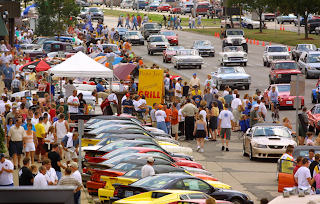
I'm not a car buff, but was there as part of a sales team experimenting with a new marketing tool—an old library book mobile that we converted and cloaked in an exciting modern "wrap" with a racing/automotive theme, from which we sell books on automotive subjects at various trade shows around the country. If you're interested, here's a link to an industry story about our experiment. The weekend was hard, hard work, but still a lot of fun and a truly fascinating cultural study. The car crowd isn't my demographic, but I was struck both by their inherent conservative patriotism, as well as by their genuine niceness.
 It's ironic how the automotive mentality still reigns in Detroit, despite the fact that the automotive industry largely deserted the region some years ago now, taking with it thousands of decent manufacturing jobs that once made Detroit a major and enviable American city. The irony is certainly lost on the crowd I hung out with this weekend, though, as Detroit is most definitely still "Motor City." At our hotel 9 miles from the cruise route, the parking lot was full of trailers that had hauled vintage and souped-up muscle cars from Texas, California, Florida, just to take part in the cruise. I talked to visitors from Austria and New Zealand and other far-flung regions who make this annual pilgrimage just to take part in the Cruise.
Detroit's woes are of course equally due to bad civic financial management, not just the betrayal of Ford, Chrysler, General Motors. And underneath the glimmer of this world class event, you see the tragedy of Detroit. Driving through residential neighborhoods, the spectacle is quite a bit different than what you might see in south-side Chicago or the grittier parts of St. Louis. In those cities, you often see entire neighborhoods abandoned. In Detroit, though, the decay is somehow even more awful, because the blight occurs in pockets in most every neighborhood. In one stretch of well constructed brick homes, about half of the homes were still valiantly maintained, with owners who were mowing their lawns, painting their trim, taking general pride in ownership like they do in any suburban neighborhood. But 10% of the homes were ugly empty shells with hollow gaping window holes. And about 30% of the homes, while still occupied, were clearly owned or rented by residents who had just given up. Here you saw unkempt lawns, window glass patched with tape, roof gutters so long unattended that virtual trees had sprouted up out of them.

Somehow this all seemed more tragic that widespread urban blight, as you can't help but sympathize with the efforts of the residents who are fighting the good fight by trying to be upstanding homeowners in the midst of a city collapsing around them.
It's also clearly a Detroit problem. On roads that straddle the boundaries between Detroit and a first-tier suburb, the Detroit side looks like a war zone, while the suburban side couldn't be more different. How can it be that Detroit look like this while adjoining Southfield, mere seconds away, still looks and functions like a workable city? I don't know a lot about the recent politics of Detroit, but surely it has been poorly managed of late.
I couldn't help but hope that Detroit succeeds in its effort declare bankruptcy and start over. Yes, the city fathers may have made some serious mistakes here, but that's not the fault of the thousands of homeowners who still live here and provide services to schools, hospitals and businesses.
Here's hoping that Detroit makes it back from the brink.
Well, that's a slight exaggeration, as a great many of the people who threw up armchairs and sunshades along the 20 mile route of the 18th annual Woodward Dream Cruise on Friday and Saturday were almost certainly folks living in the immediate greater Detroit region. Still, though, it was estimated that several hundred thousand people drove and flew substantial distances to participate on this spectacle, which takes place annually in late August.
The Woodward Dream Cruise is a celebration of all things automotive, and especially the high-powered "muscle cars" over which car buffs drool. There were thousands of these cars roaring up and down the avenue at the event, ranging from just pristinely restored and maintained "factory" vehicles, to elaborately enhances monsters with engines that bulged up above the hoods like aggressive tumors, roaring their distain for mere mechanical competence. The business parking lots all along the avenue are given over to food vendors and shiny aftermarket parts for these few days. Nascar superstars are on hand signing autographs. At the many car dealers still lining the avenue, pretty blonde girls in tight tank-tops hawk the latest models from the auto companies who now make their vehicles in Canada or Tennessee or China rather than this area. The whole atmosphere is like a renaissance festival, albeit one where motor oil is the currency.

I'm not a car buff, but was there as part of a sales team experimenting with a new marketing tool—an old library book mobile that we converted and cloaked in an exciting modern "wrap" with a racing/automotive theme, from which we sell books on automotive subjects at various trade shows around the country. If you're interested, here's a link to an industry story about our experiment. The weekend was hard, hard work, but still a lot of fun and a truly fascinating cultural study. The car crowd isn't my demographic, but I was struck both by their inherent conservative patriotism, as well as by their genuine niceness.

Detroit's woes are of course equally due to bad civic financial management, not just the betrayal of Ford, Chrysler, General Motors. And underneath the glimmer of this world class event, you see the tragedy of Detroit. Driving through residential neighborhoods, the spectacle is quite a bit different than what you might see in south-side Chicago or the grittier parts of St. Louis. In those cities, you often see entire neighborhoods abandoned. In Detroit, though, the decay is somehow even more awful, because the blight occurs in pockets in most every neighborhood. In one stretch of well constructed brick homes, about half of the homes were still valiantly maintained, with owners who were mowing their lawns, painting their trim, taking general pride in ownership like they do in any suburban neighborhood. But 10% of the homes were ugly empty shells with hollow gaping window holes. And about 30% of the homes, while still occupied, were clearly owned or rented by residents who had just given up. Here you saw unkempt lawns, window glass patched with tape, roof gutters so long unattended that virtual trees had sprouted up out of them.

Somehow this all seemed more tragic that widespread urban blight, as you can't help but sympathize with the efforts of the residents who are fighting the good fight by trying to be upstanding homeowners in the midst of a city collapsing around them.
It's also clearly a Detroit problem. On roads that straddle the boundaries between Detroit and a first-tier suburb, the Detroit side looks like a war zone, while the suburban side couldn't be more different. How can it be that Detroit look like this while adjoining Southfield, mere seconds away, still looks and functions like a workable city? I don't know a lot about the recent politics of Detroit, but surely it has been poorly managed of late.
I couldn't help but hope that Detroit succeeds in its effort declare bankruptcy and start over. Yes, the city fathers may have made some serious mistakes here, but that's not the fault of the thousands of homeowners who still live here and provide services to schools, hospitals and businesses.
Here's hoping that Detroit makes it back from the brink.
Saturday, July 27, 2013
Saturday Breakfast

I had breakfast in the garden this morning. I mean this more literally than in the usual sense, as it
wasn't a matter of me carrying around a cup of coffee and a slice of toast as I sat at a patio table and enjoyed the morning. The raspberries are at last in full bearing mode, cherry and pear tomatoes are ripening, the herb containers on the deck are fragrant, and the first green and yellow peppers are ripe. It's not like my wife and I are prodigious vegetable gardeners; we actually lean more toward the ornament side in our gardening tastes, but we do grow enough edibles to offer enough for two middle-aged folks during the growing season. This morning's breakfast was a matter of literally plucking the food from the canes, stalks, and vines and munching them whole while wandering around the early morning garden.

Over the course of two hours, I felt some of the tension from the week drain away into the earth; gardens for me are literally grounding, soaking up

This morning, anyway, that sense of well-being is profound indeed.
Friday, July 26, 2013
Liberals Have Deserted Me.
I'm seriously considering leaving a club to which I've belonged for my entire life—the liberals.
All my life, friends and acquaintances who are moderate in political and social outlook have regarded me as extremely left-wing in attitude—one close friend openly thinks of me blatantly socialist. But lately my liberal sisters and brothers are beginning to piss me off in the extreme, mostly because they project false arrogance and superiority that is just insufferable. The liberals who are bugging me come in several sub-species, among them:
The restaurant and coffeeshop snobs
Lord, am I tired of the aristocrats for whom the only thing acceptable is the newest, most
expensive restaurant in town. Very rarely I've found some of these places to be really nice dining experiences, but generally speaking the busiest restaurants have little legitimate to recommend them other than the fact that human lemmings are swarming them for the moment. Fully ninety percent of these trendy places offer fare that has less taste than what you'd eat at a simple Perkins family restaurant. It's entirely false snobbishness that fuels the silly popularity of these places.
Similarly, I'm terribly tired of the coffee boutiques specializing in syrupy fluids with flavor that reminds you of the bottom of an ashtray. Let's face it: old time diners offered coffee with a pleasantly nutty flavor that surpassed most of the nonsense served in the upscale coffee boutiques.
The health food nuts
At various times lately, I've heard it said that virtually all world health problems, from autism to dementia, are due to:
• Gluten
• Sugar
• Lactose
• Statin drugs
• Red meat
• Protein
• Carbohydrates
• Caffeine
• Artificial Sweeteners
• Too many intestinal bacteria
• Not enough intestinal bacteria
Good grief. It's interesting to me that the folks frantically afraid of these health nemeses seem to be the ones who then develop them. (The real health problem is narcissistic hypochondria). Meanwhile, I know perfectly healthy octogenarians who have consumed liquor and stiff coffee, smoked cigarettes and practiced all manner of debauchery and are are still alive and kicking rigorously.
It wouldn't be so bad if these food neurotics didn't insist on preaching to you their brand of insanity. At a recent neighborhood picnic, one fellow interrogated each person who had brought a potluck dish on whether their recipes were "gluten free" or not. Several were asked to go check labels to find out if he could eat without farting up a storm a couple of hours later.
And I have no need to convince vegetarians and "vegans" that their practices are somewhat against the biological heritage of homo-sapiens. It's no skin off my nose if they want to live this way. So why is it that when you eat a bit of fish and a sour-dough roll in front of them, they can barely disguise their contempt?
Pseudo hippies
I really don't have anything against the true children of the 60s and 70s who continue to live the
principles of that era, though it often seems just a little silly. Most of us from that generation have evolved a bit, or at least become a little more realistic about some aspects of the world, but it seems to me that these folks have earned the right to practice a philosophy that's natural to them. And there is a political genuineness (though perhaps not practical realism) that I rather admire.
But I'm increasingly surprised by the number of young (late 20s to early 40s) liberals who adopt a kind of false hippie aesthetic without any real idea of the underpinnings. On the commuter bus one casual Friday, I heard two young women comparing the quality of tie-dye skirts between Macy's and Nordstroms, one arguing that paying $250 was a good investment, as the designer was much more on-trend. The idea that such garments were created by hand back in the day was utterly alien to them, I imagine.
These pseudo hippies are frankly as blatantly materialistic as any 1970's yuppie that we used to ridicule. They've just deluded themselves into believing they are superior to other people.
Lords of craft beer
Here's another trend that's starting to annoy me—the obsession with "craft" beer. Surely this has about run its course. It's really nothing more than the latest iteration of wine snobbery. if you ask me. I've nothing again microbreweries—who could be against having more pubs around the neighborhood? But the level of gourmet pretension has become pretty unbearable. Beer is beer, and its the act of tipping back with your pals that is significant, not silly debate on the aesthetics of the decor and furnishings in one microbrewery over the other.
(Note: Scotch snobbery is not to be criticized, under severe penalty)
Parents who "befriend" their children
This isn't all that new; some fellow liberals back when we started having kids were also practicing this way. What I'm speaking of are those parents who have no ability to distinguish between the adults and the children. They treat their kids as friends, sometimes even encouraging kids to address mom and dad by first names. And in the homes of these folks, you'll find no distinction between spaces for the kids and those for adults—toys and games are scattered everywhere, and the entire family culture is dominated by the needs and wishes of kids. These are the folks who will never leave kids with a baby-sitter in order to go out and get stinking drunk and screw in the backseat. Because they are ordained by god almighty to raise supermen and superwomen, they are likely to home school their kids, because of course contact with other people is not necessary for a growing kid. They are the ones who insist that you need not discipline kids; only "reason" with them. (One fellow preached this to me, then in the next breath lamented that his 10-year old son had begun stealing from the neighbors after breaking through their windows).
Spare me. Parents should have no fear of being parents and making sure their kids understand that that they are the kids. Give the kids some space; your constant presence in every aspect of their lives is not very healthy.
The bicycle frauds
I work with some of these folks, who exhibit an insolent moral superiority in the fact that they
ride bicycles everywhere while others drive automobiles. Does a 50-year old bicycle commuter really have any reason to where spandex biking togs with racing numbers on the back? In cultures where bicycling is far more ingrained (England, for example), folks ride bikes in comfortable clothing, not ridiculous costumes.
And I'm entirely weary of the indignant, defiant way that bicyclists now treat traffic laws, living in constant deliberate combat with automobiles. Now, I have no problem if bicyclists want to run a stop sign or red light, frankly, Generally, it's no skin off my nose, and I frankly am ready to offer some social leniency to those who are saving gasoline. But at the same time, you do this at your own risk, and running a traffic stop means you must be willing to take responsibility for the consequences. Everywhere today I see bikes whizzing through intersections as though they have god-given right of way, paying no attention to cross traffic, and then filing lawsuits if they plow broadside into a car.
The television snobs
I know quite a number of educated liberals who sniff with superiority if you mention that you enjoy a particular television program or frequently watch ballgames on the tube. Apparently they only read greek literature and study classic music for entertainment in the evenings. These are the folks who deny their kids television viewing or access to computer games due to a sense of moral superiority: it's the "we practice arts and crafts at our house rather than watch TV" group.
This is just horse crap. Television is inherently no more corrupting (and likely less so) than reading romance novels, or listening to Taylor Swift on the ipod, which is what a lot of these holier-than-thou sorts do on the sly. Steven Spielberg acknowledges that he watched television constantly as a youth, as did any number of creative and famous individuals. Probe a little bit and you'll find that these folks who claim to have never watched television can sing you the theme song to most every 1970s sitcom.
So I'll just say it: the big-screen, high-def television is illuminated and talking quite a bit of the time at our house, and we kind of treat it as a window that can be looked through when you want. As Joseph Campbell noted, studying a society's popular culture tells you far more about it than scholarly tomes.
I read three books a week, on average. But I also can't wait for the next episode of "Hillbilly Handfishin'" on the History Channel. It airs right before "Say Yes to the Dress."
.....I clearly need a new club. Time was when liberals were a 'live and let live' crowd, not a bunch of moralistic namby pambies.
I wonder the entry requirements are for the Libertarians.
All my life, friends and acquaintances who are moderate in political and social outlook have regarded me as extremely left-wing in attitude—one close friend openly thinks of me blatantly socialist. But lately my liberal sisters and brothers are beginning to piss me off in the extreme, mostly because they project false arrogance and superiority that is just insufferable. The liberals who are bugging me come in several sub-species, among them:
The restaurant and coffeeshop snobs
Lord, am I tired of the aristocrats for whom the only thing acceptable is the newest, most
 |
| Seriously? I asked for a cup o' Joe, black. |
Similarly, I'm terribly tired of the coffee boutiques specializing in syrupy fluids with flavor that reminds you of the bottom of an ashtray. Let's face it: old time diners offered coffee with a pleasantly nutty flavor that surpassed most of the nonsense served in the upscale coffee boutiques.
The health food nuts
At various times lately, I've heard it said that virtually all world health problems, from autism to dementia, are due to:
• Gluten
• Sugar
• Lactose
• Statin drugs
• Red meat
• Protein
• Carbohydrates
• Caffeine
• Artificial Sweeteners
• Too many intestinal bacteria
• Not enough intestinal bacteria
Good grief. It's interesting to me that the folks frantically afraid of these health nemeses seem to be the ones who then develop them. (The real health problem is narcissistic hypochondria). Meanwhile, I know perfectly healthy octogenarians who have consumed liquor and stiff coffee, smoked cigarettes and practiced all manner of debauchery and are are still alive and kicking rigorously.
It wouldn't be so bad if these food neurotics didn't insist on preaching to you their brand of insanity. At a recent neighborhood picnic, one fellow interrogated each person who had brought a potluck dish on whether their recipes were "gluten free" or not. Several were asked to go check labels to find out if he could eat without farting up a storm a couple of hours later.
And I have no need to convince vegetarians and "vegans" that their practices are somewhat against the biological heritage of homo-sapiens. It's no skin off my nose if they want to live this way. So why is it that when you eat a bit of fish and a sour-dough roll in front of them, they can barely disguise their contempt?
Pseudo hippies
I really don't have anything against the true children of the 60s and 70s who continue to live the
 |
| Sorry pal. Abbie Hoffman you ain't. |
But I'm increasingly surprised by the number of young (late 20s to early 40s) liberals who adopt a kind of false hippie aesthetic without any real idea of the underpinnings. On the commuter bus one casual Friday, I heard two young women comparing the quality of tie-dye skirts between Macy's and Nordstroms, one arguing that paying $250 was a good investment, as the designer was much more on-trend. The idea that such garments were created by hand back in the day was utterly alien to them, I imagine.
These pseudo hippies are frankly as blatantly materialistic as any 1970's yuppie that we used to ridicule. They've just deluded themselves into believing they are superior to other people.
Lords of craft beer
Here's another trend that's starting to annoy me—the obsession with "craft" beer. Surely this has about run its course. It's really nothing more than the latest iteration of wine snobbery. if you ask me. I've nothing again microbreweries—who could be against having more pubs around the neighborhood? But the level of gourmet pretension has become pretty unbearable. Beer is beer, and its the act of tipping back with your pals that is significant, not silly debate on the aesthetics of the decor and furnishings in one microbrewery over the other.
(Note: Scotch snobbery is not to be criticized, under severe penalty)
Parents who "befriend" their children
This isn't all that new; some fellow liberals back when we started having kids were also practicing this way. What I'm speaking of are those parents who have no ability to distinguish between the adults and the children. They treat their kids as friends, sometimes even encouraging kids to address mom and dad by first names. And in the homes of these folks, you'll find no distinction between spaces for the kids and those for adults—toys and games are scattered everywhere, and the entire family culture is dominated by the needs and wishes of kids. These are the folks who will never leave kids with a baby-sitter in order to go out and get stinking drunk and screw in the backseat. Because they are ordained by god almighty to raise supermen and superwomen, they are likely to home school their kids, because of course contact with other people is not necessary for a growing kid. They are the ones who insist that you need not discipline kids; only "reason" with them. (One fellow preached this to me, then in the next breath lamented that his 10-year old son had begun stealing from the neighbors after breaking through their windows).
Spare me. Parents should have no fear of being parents and making sure their kids understand that that they are the kids. Give the kids some space; your constant presence in every aspect of their lives is not very healthy.
The bicycle frauds
I work with some of these folks, who exhibit an insolent moral superiority in the fact that they
 |
| Got news for you. This ain't the tour de France. |
And I'm entirely weary of the indignant, defiant way that bicyclists now treat traffic laws, living in constant deliberate combat with automobiles. Now, I have no problem if bicyclists want to run a stop sign or red light, frankly, Generally, it's no skin off my nose, and I frankly am ready to offer some social leniency to those who are saving gasoline. But at the same time, you do this at your own risk, and running a traffic stop means you must be willing to take responsibility for the consequences. Everywhere today I see bikes whizzing through intersections as though they have god-given right of way, paying no attention to cross traffic, and then filing lawsuits if they plow broadside into a car.
The television snobs
I know quite a number of educated liberals who sniff with superiority if you mention that you enjoy a particular television program or frequently watch ballgames on the tube. Apparently they only read greek literature and study classic music for entertainment in the evenings. These are the folks who deny their kids television viewing or access to computer games due to a sense of moral superiority: it's the "we practice arts and crafts at our house rather than watch TV" group.
 |
| Yup. That's me, Mercurious. And proud of it. |
This is just horse crap. Television is inherently no more corrupting (and likely less so) than reading romance novels, or listening to Taylor Swift on the ipod, which is what a lot of these holier-than-thou sorts do on the sly. Steven Spielberg acknowledges that he watched television constantly as a youth, as did any number of creative and famous individuals. Probe a little bit and you'll find that these folks who claim to have never watched television can sing you the theme song to most every 1970s sitcom.
So I'll just say it: the big-screen, high-def television is illuminated and talking quite a bit of the time at our house, and we kind of treat it as a window that can be looked through when you want. As Joseph Campbell noted, studying a society's popular culture tells you far more about it than scholarly tomes.
I read three books a week, on average. But I also can't wait for the next episode of "Hillbilly Handfishin'" on the History Channel. It airs right before "Say Yes to the Dress."
.....I clearly need a new club. Time was when liberals were a 'live and let live' crowd, not a bunch of moralistic namby pambies.
I wonder the entry requirements are for the Libertarians.
Subscribe to:
Posts (Atom)